
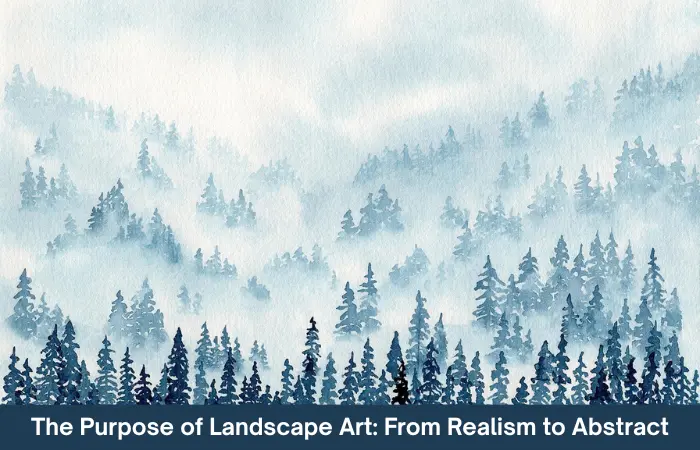
Have you ever stood before a painting of an open landscape and felt the wind brushing your hair, or the smell of fresh grass soothing your sense of smell, and the sounds of distant waves sing to your ear?
This is what the landscape art does to you and for you. Landscape arts exist not because hills and valleys are pretty. It exists because every landscape is a language. And people who can read this language can truly feel the size and scale.
One of the biggest aspects of landscape painting is how it reflects scale and reminds us that human existence is fragile and mortal. This idea is also seen in Pattachitra, where vast natural and mythological settings place humans within a larger, timeless world.
Birth Of A Genre: Landscape Art
To truly understand how landscape paintings over time, we need to trace their inception. In Europe, the landscape was late to earn its independence. For centuries, it served as a backdrop for sacred or heroic narratives. It was even ranked below “history” painting in academic hierarchies.
Renaissance optics and later Dutch markets opened a path: the Protestant middle class bought secular scenes for private homes; academies slowly softened; artists found livelihoods depicting river light, farm fields, and everyday weather.
Since then, landscape artworks have become a staple and have gone through several different iterations.
Also Read: Things to Check Before Buying a Mini LED TV
The Eastern Turn
While one part of the world was still learning the ropes of landscape paintings, the eastern side of the globe was already exploring the metaphysical aspect of the format.
For example, in Chinese shan-shui (mountain-water) painting, landscape was never merely an accessory; it was a vehicle for moral cultivation and metaphysical inquiry.
Through the Tang, Song, and Qing dynasties, artists staged dialogues between person and cosmos, not by copying appearances but by balancing voids, rhythms, and calligraphic energies.
In this lineage, the landscape’s purpose is spiritual and ethical. It was an exercise in harmony more than a mirror of sight.
Realism’s Promise
Realism arrives with a promise of truth. In the 17th‑century Netherlands, painters like Jacob van Ruisdael embedded symbolic weather and architecture inside scrupulous topographies, dovetailing with a new, civic sense of place.
Realism’s purpose here operates on several levels: to document, to dignify the ordinary, to reassure a community of its own image, and to encode meanings that reward careful viewing. Realism, then, is not naïve copying; it’s a social mirror polished to reflect shared hopes and anxieties.
The Abstraction Pivot
The 20th century loosened the painted world. Kandinsky, Malevich, and Mondrian suspected that meaning could outpace mimesis. If color, line, and rhythm could transmit inner states, then why tether them to literal trees and clouds?
Abstraction reframed the purpose of landscape from “what it looks like” to “how it feels” or “what it means to the spirit.” That doesn’t erase realism; it shifts the center of gravity toward mood, concept, and essences.
Contemporary overviews of abstraction emphasize this turn to spiritual resonance and subjective truth; it’s the point at which a horizon line can vanish, yet the sensation of wind remains (or intensifies).
The Productive Middle
Most artists don’t choose a permanent camp at either extreme; they walk the fence. Some label the approach “abstract realism”; others simply keep what serves the feeling and release what doesn’t.
Painters who work in this middle distance report a distinct kind of purpose, to keep the world recognizable enough to anchor the viewer while remaining open enough to invite projection.
The Scottish artist Sarah Burns writes about this tug: the addictive thrill of getting something “right” versus the deeper, riskier satisfaction of letting ambiguity speak.
Her essay reads like a studio confession, but implicitly it’s a theory of purpose: representation as proof, abstraction as freedom, and the sweet spot as authenticity.
You can see cousins to this stance in contemporary tonalist and minimal landscape practices, works that hover on the cusp of recognition, using restrained value shifts or broad fields to suggest shoreline, grove, or fog without dictating every twig.
The intent is not to hide information, but to give viewers space to find theirs. That, too, is a purpose.
Genius Loci
Romans really saw the symbolic profundity of landscape and managed to inculcate it into their theoretical understanding. The Romans named it genius loci, the spirit of a place.
Contemporary cultural analysis has revived the term to describe how artworks carry the atmosphere and identity of locales, compressing material (weather, geology, light) and immaterial (history, ritual, loss) into a single felt presence.
Read this way, a landscape isn’t “of” a place so much as it is a place again, for the duration of the looking. Purpose here converges: to remember, to belong, to argue for the value of a site, to preserve a mood from erasure.
The theory also clarifies why abstraction can feel truer than detail; the spirit of place sometimes lives in tempo and color more than in taxonomy.
Understanding The Symbolism
Landscape artwork is not just about capturing the natural beauty of the world. It is also about understanding the symbolism within landscapes. The natural phenomena are shaped in a way that they depict certain human emotions or state. For example, storm as upheaval, sunrise as hope, or road as fate.
These antiquated ideas represent how viewers metabolize landscapes into personal narratives. In fact, this tendency can be seen in modern times as well. For example, skyline is shown as aspirational.
Therefore, landscape is not just about existentialism. There is a deep-seated meaning behind those expanses.
How Consumption Language Changes
The language of human consumption is definitely one of the most dynamic things that is in a constant state of flux. Therefore, as the language of consumption is changing, so is the representation.
Even though modern human beings do not associate landscape with metaphoric imagery, they are certainly potent to invoke a sense of scale. While most people use these artworks as biophilic decor or canvas wall art, there is more to them.
Landscape paintings are not just random imagery of the geographical features, but a deep look into unspoken emotions and understanding.

I’m Kishan Rana, an SEO professional and digital marketing specialist with over 8 years of hands-on experience in search engine optimization, organic growth strategies, and online visibility enhancement. I’m passionate about analyzing search algorithms, exploring ranking strategies, and helping businesses build sustainable traffic through data-driven SEO practices. Through Mashupmind, I share practical insights, industry trends, and actionable techniques designed to help brands grow smarter in the digital landscape.