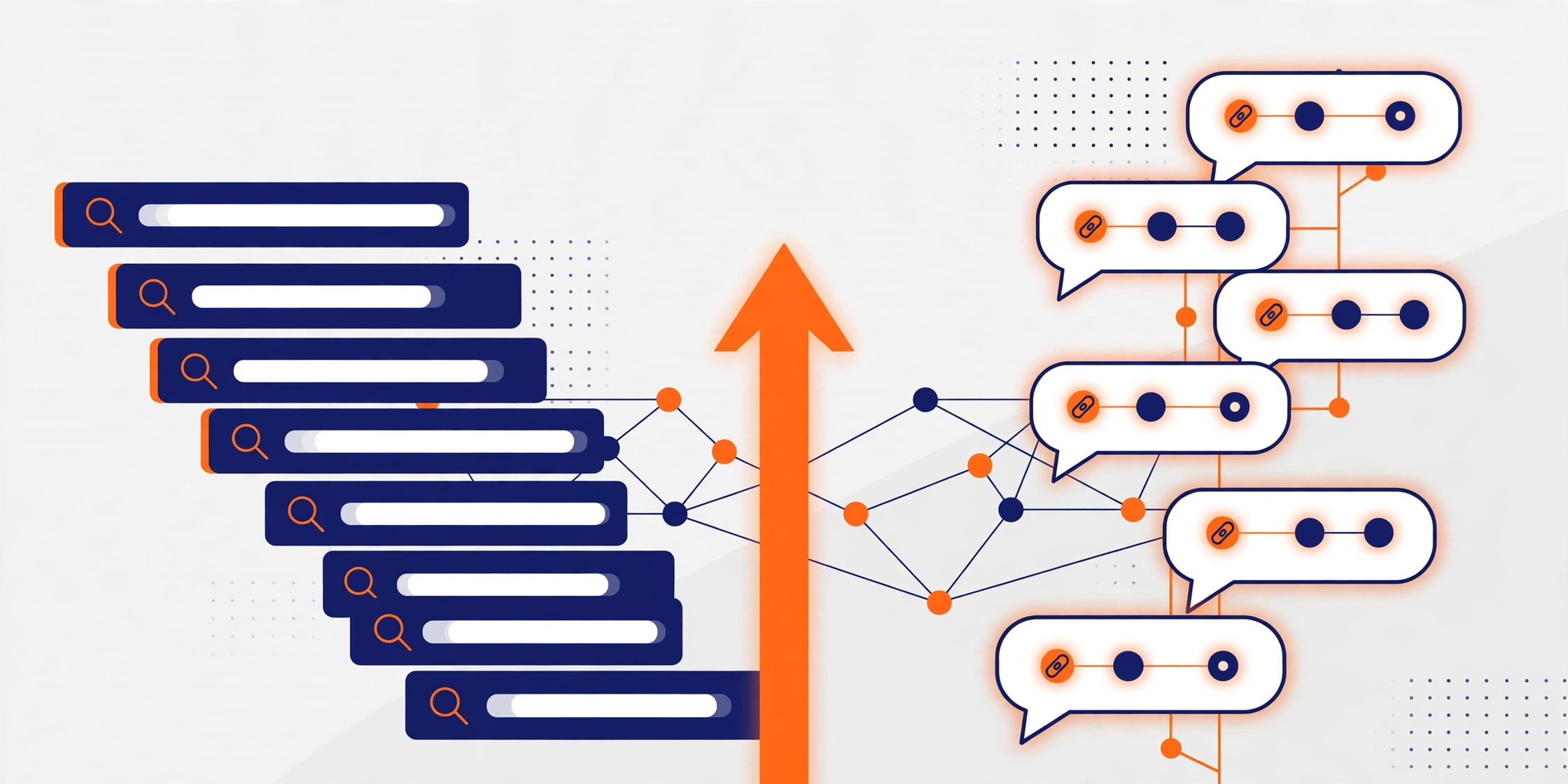

Ranking number one used to mean traffic. In 2026, it often means something smaller: a citation inside an answer your prospect reads without ever visiting your site. For SaaS brands, that shift is not a future trend. It is already showing up in the numbers, and the brands winning now are the ones changing what they optimise for — from rank alone to rank plus citation.
This post lays out what the latest studies actually say, why SaaS feels the change first, and a practical playbook your team can run in the next 30 days.
What the numbers actually say
Headlines about AI search disagree wildly on percentages. That is because every study measures a different sample of searches. Read them together, though, and the direction is consistent: fewer clicks per impression when an AI answer appears, and a big advantage for brands that get cited inside it.
| Study | What it found | Read it as |
|---|---|---|
| Ahrefs, 300,000 keywords (March 2025, updated with December 2025 data) | Position-one click-through rate fell 34.5% when an AI Overview was present, widening to about 58% in the 2026 update. | The click penalty is growing, not shrinking. |
| Pew Research Center, July 2025 (900 US adults, 68,879 real searches) | Users clicked a regular result on 8% of visits with an AI summary, versus 15% without one. Only 1% of visits produced a click on a link inside the summary. | Being visible is no longer the same as being visited. |
| Agarwal & Sen field experiment, preliminary draft 2026 (1,065 US users, January–February 2026) | Showing an AI Overview cut outbound organic clicks by about 38% and raised zero-click searches by about a third. | The strongest evidence yet, because it is randomised, not just observed. |
| Serplify, October 2026 (494 US desktop searches) | 77% of searches showed an AI Overview, including 97% of question searches and 97% of ‘best’ or ‘vs’ searches. Only 26% of cited links were also top-10 organic results. | AI citations and organic rankings are increasingly different games. |
| Washington University crawl, March–April 2026 (55,393 trending queries) | AI Overviews appeared on 13.7% of all trending queries, but 64.7% of question-form queries. | The query type matters more than the average. |
Two honest caveats before we go further. First, Google has publicly disputed the methodology of some of these studies, and exact percentages vary by sample — treat them as direction, not as a forecast for your site. Second, presence keeps climbing on commercial queries: Semrush tracked a panel of buying-stage keywords (alternatives, brand-versus-brand, best, pricing, reviews) and saw AI Overview coverage rise from 45.75% to 88% between September 2025 and August 2026. Google said at I/O in May 2026 that AI Overviews reach more than 2.5 billion monthly users. This is the mainstream now, not an experiment.
Sources for the figures above: Ahrefs, Pew and Seer findings summarised, Serplify’s October 2026 study, and Ahrefs and Pew impact data.
Why SaaS feels this first
SaaS buyers ask exactly the kinds of questions AI Overviews love to answer: ‘best CRM for small teams’, ‘Tool A vs Tool B’, ‘how much does X cost’, ‘alternatives to Y’. Those comparison and pricing queries trigger AI answers at very high rates, and the answer often settles the shortlist before a single website visit happens.
That changes the job of SaaS content. A page that ranks third but gets cited in the AI answer can now outperform a page that ranks first but is ignored by it. And a page that only repeats what every competitor says gives the AI nothing to cite — it will quote someone else’s original data, framework, or verdict instead.
This is also why links and mentions now work as a pair. Links still carry authority; mentions and citations carry the brand recognition AI systems use when they choose sources. We covered that two-stack in detail in Links vs Mentions: The Two-Stack SaaS Link Building Playbook for AI Search.
The 2026 playbook: five moves that actually work
1. Win the citation, not just the ranking
AI answers lift passages that are self-contained, factual, and easy to attribute. Structure every key page so it can be quoted:
- Open with the direct answer to the target question, in two or three sentences, before any background.
- Give each section one question as its heading, phrased the way buyers actually ask it.
- Put load-bearing facts in tables and short lists, with the source named next to the number — not buried three paragraphs away.
- Publish original material AI cannot get elsewhere: your own benchmarks, test results, pricing observations, or a framework with a name. Generic advice gets summarised; original evidence gets cited.
2. Make your brand an entity, not a keyword
AI systems cite brands they can identify confidently. That means consistency everywhere: the same brand name, the same description of what you do, a real About page, named authors with real credentials, and a steady stream of independent mentions. A brand that appears in editorial coverage, comparisons, and expert lists is easier to cite than a brand that only exists on its own site. Our guide to earning that coverage is Digital PR for SaaS: How to Earn Editorial Links That Actually Move Rankings.
3. Build pages AI trusts
Depth beats volume. A page with first-hand testing, clear reasoning, honest drawbacks, and a visible update date is citable; a thin page spun around a keyword is not. Show your working: how you tested, what you measured, what changed since the last update, and where you disagree with the conventional wisdom — with reasons. Keep internal links genuinely helpful, guiding readers (and crawlers) from overview pages to the detailed evidence behind each claim. If you run SEO services content, this is the standard every page should meet before it ships.
4. Measure what matters now
Rank tracking alone will mislead you in 2026. Add these to your monthly report:
- Search Console’s AI Overview impressions and clicks for your key pages, tracked separately from classic organic.
- Citation checks: for your top 20 money queries, is your brand cited in the AI answer, linked, or absent? Track it monthly — it moves independently of rank.
- Branded versus non-branded traffic, so AI-driven brand discovery is not mistaken for a ranking loss (or vice versa).
- Assisted conversions: a visitor who first met you inside an AI answer and converted later still counts, even if the last click looks like direct or branded search.
Do not panic over a single bad week. AI answers change frequently for the same query; judge trends over a month, not a day.
5. Use paid to cover the gap organic leaves
Where AI answers shrink organic clicks on high-intent queries, paid search still puts you in front of buyers at the moment of decision. The smart move is not ‘SEO versus PPC’ but a split: organic and citations for research and comparison queries, paid for the bottom-funnel terms where a lost click is a lost demo. Rising click costs make that split a budgeting decision, not an afterthought — see SaaS PPC in 2026: What Rising Click Costs Mean for Your Budget and our PPC services.
What not to do
- Do not mass-produce thin ‘AI answer’ pages. Scaled, low-value pages are a spam risk and give AI nothing original to cite.
- Do not build doorway variants for every keyword variation. Consolidate pages that serve the same task.
- Do not plant prompt-style text or fake endorsements aimed at steering AI answers. That is manipulation, and it puts the site at risk.
- Do not block AI crawlers in a panic. Blocking may remove you from answers entirely — including the citations you want. Decide crawler policy deliberately, per content type, not in reaction to one traffic dip.
- Do not chase every query. Own the queries tied to your buyers’ decisions; ignore the rest.
A 30-day starter plan
Week 1 — Audit: list your top 20 money queries. For each, record rank, AI Overview presence, and whether you are cited. That is your baseline.
Week 2 — Fix the top 5 pages: add answer-first openings, one-question sections, a facts table with named sources, and an update date. No new pages yet.
Week 3 — Publish one original asset: a benchmark, a test, or a comparison built from your own data. Pitch it for editorial coverage — citations follow coverage.
Week 4 — Measure and budget: set up the AI Overview and citation tracking above, and reallocate a slice of budget to paid for the high-intent queries where organic clicks fell most.
FAQs
Is SEO dead because of AI Overviews?
No. Search is changing shape, not disappearing. Rankings still matter, but they now share the job with citations, mentions, and brand recognition. Teams that optimise for all three keep their pipeline; teams that optimise for rank alone watch clicks fall while positions hold.
Should we block AI crawlers from our site?
Usually not as a first move. Blocking removes you from AI answers altogether. The better default is to stay visible, make your best pages citation-worthy, and only restrict specific content (such as gated or licensed material) for a clear business reason.
Does ranking number one still matter?
Yes, but it is no longer sufficient. The number-one result still earns the most clicks of any single result — yet on AI Overview queries it earns far fewer than it used to, and a cited lower-ranked page can beat an uncited top page. Aim for rank plus citation.
How do we actually get cited by AI Overviews?
Be the clearest, most credible source on a specific question: a direct answer early, named sources for facts, original data or testing, consistent brand identity, and independent mentions elsewhere. There is no submission form and no guaranteed route — citations are earned by being quotable.
How fast should we act?
Start this month with the audit and the top-5 page fixes. Coverage on commercial and question queries is already high, and the click penalty has grown year over year. Waiting for a ‘stable’ AI search landscape means waiting while competitors become the cited source.
The bottom line
AI Overviews did not kill search demand — they moved the moment of decision earlier, into the answer itself. SaaS brands that answer first, publish original evidence, build a recognisable brand entity, and measure citations alongside rankings will keep being found. Brands that only chase positions will keep wondering where their clicks went.
If you want help running this playbook — citation audit, answer-first content, and the link and mention building behind it — explore MashupMind’s SEO services or book a call with the team.

I’m Kishan Rana, an SEO professional and digital marketing specialist with over 8 years of hands-on experience in search engine optimization, organic growth strategies, and online visibility enhancement. I’m passionate about analyzing search algorithms, exploring ranking strategies, and helping businesses build sustainable traffic through data-driven SEO practices. Through Mashupmind, I share practical insights, industry trends, and actionable techniques designed to help brands grow smarter in the digital landscape.