Picture a SaaS team that did everything right by the old playbook. Their comparison page ranks on page one for its money keyword. Their backlink profile is clean, their referring domains grow every month, and their domain rating looks respectable in every sales deck. Then a prospect asks ChatGPT for the best tool in their category, and their brand is never named. A competitor with fewer links gets cited instead.
That gap is the story of SaaS link building in 2026. The discipline has split into two jobs, and most teams are still only doing one of them. This guide explains the split, the evidence behind it, and a practical programme that earns both Google rankings and AI citations at the same time.
What actually changed in 2026
For years, link building had one customer: Google’s ranking algorithm. A link was a vote, votes moved rankings, and rankings brought traffic. That model still works, but it is no longer the whole market. A large share of B2B software discovery now passes through AI answers first — ChatGPT, Perplexity, Google’s AI Overviews and AI Mode — and those systems do not retrieve the web the way Google’s ten blue links do.
The evidence became hard to ignore in 2026. Ahrefs studied 75,000 brands and measured which signals lined up with being mentioned in ChatGPT, AI Mode and AI Overviews. Branded web mentions correlated at roughly 0.66 to 0.71 with AI visibility, while backlinks showed only a weak correlation, and domain rating correlated at just 0.266 for ChatGPT. Correlation is not causation, and no single study settles a fast-moving question, but the direction is consistent across independent write-ups of the same data: engines cite brands that the web talks about, not only brands that the web links to.
A second, smaller October 2026 measurement pointed the same way from a different angle. Across 50 commercial queries, the pages cited inside Google’s AI Overviews carried a median of 58 referring domains, while the pages ranking in the organic top ten underneath those answers carried a median of just 5, once platform domains like YouTube and Reddit were excluded from both sides. The cited set and the ranked set were often not the same pages at all. On 27 of 49 queries, not one of the ten organic URLs was cited in the AI Overview above it.
Two older facts frame why this happened. Google’s Gary Illyes has said links have not been a top-three ranking factor for some time, and industry surveys repeatedly find that roughly two-thirds of B2B buyers prefer a rep-free buying experience — they compare vendors through listicles, comparison pages, communities and AI answers before sales ever hears their name. The buyer journey moved; the link building job had to move with it.
The two stacks, side by side
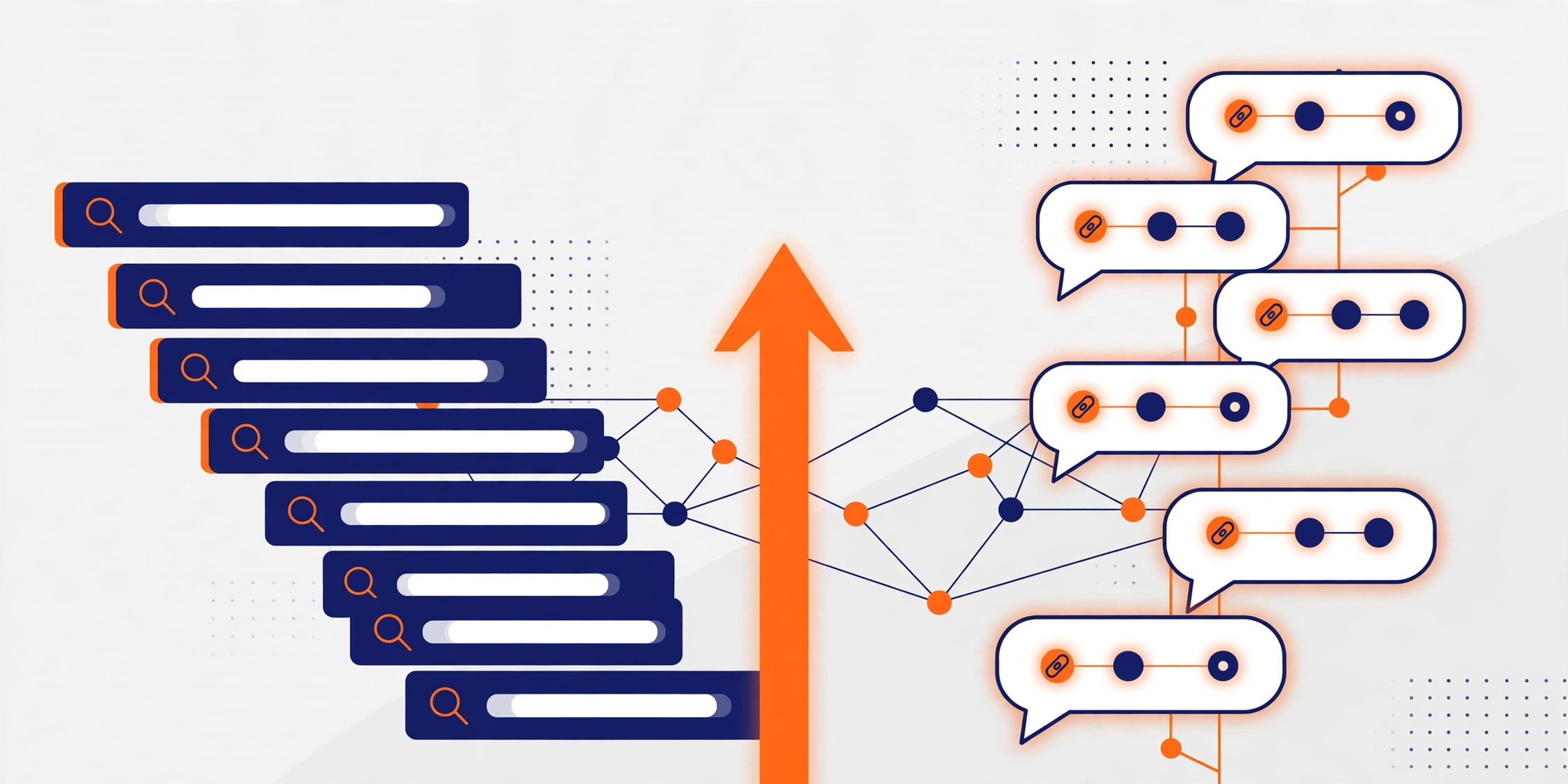
Think of the work as two stacks with different goals, different surfaces and different scoreboards. Most struggling programmes are not lazy; they are running one stack and wondering why the other scoreboard stays at zero.
| Dimension | SERP stack (Google rankings) | Citation stack (AI answers) |
|---|---|---|
| Goal | Rank commercial and comparison pages | Get named and cited in AI answers |
| What counts most | Relevant editorial links to the ranking page itself | Branded mentions, linked and unlinked, across trusted sources |
| Where it shows up | Google’s organic results | ChatGPT, Perplexity, Gemini, AI Overviews, AI Mode |
| Best inputs | Guest posts, HARO, resource pages, digital PR with links | Listicles, original data, community presence, editorial coverage |
| How you measure it | Rankings, referring domains to the URL, organic conversions | Branded mentions, citation frequency across repeated queries |
| Timeline | Weeks to months of compounding | Weeks to months of compounding |
The stacks overlap but they are not interchangeable. A link from a niche publication your buyers trust can feed both: it lifts the ranking page and it puts your brand name in a source AI systems retrieve. A link from an irrelevant high-authority site may help neither. That is why the old metric — domain rating alone — is a poor buying guide in 2026. Topical relevance and real readership now beat a big number. If you want the full reasoning on the tactics that feed the first stack, our SaaS link building strategies guide and our link building for SaaS overview cover them in depth.
What earns AI citations now
AI engines corroborate claims across independent third-party coverage before recommending a product. A brand that appears once, on its own site, is a claim. A brand that appears consistently, in the same category, across independent sources, is a consensus. Five moves build that consensus.
1. Get into the listicles that already rank. When buyers search “best [category] software,” the listicles that rank are often the same pages AI engines cite when they answer. Earning a named slot on those pages — with an accurate description, pricing context and a real differentiator — is now a link building task, not just a PR task. It is also the fastest way to check your standing: run a buyer query through an AI tool three times and note which brands get cited repeatedly.
2. Keep your entity information consistent everywhere. AI systems resolve brands as entities: name, category, what the product does, who it is for. If your site says one thing, your directory profiles say another, and a review site says a third, the engine has less confidence in naming you. Consistent descriptions, categories and facts across your site, profiles and coverage are unglamorous work that compounds.
3. Publish original data nobody else has. Benchmarks, pricing studies, usage data and survey results are the most citable assets in this environment because AI answers need sources for claims. A data-led campaign can earn editorial links and unlinked mentions from the same effort, which is why it sits at the top of our digital PR for SaaS playbook.
4. Be present where AI systems retrieve. Reddit, YouTube and Wikipedia appear frequently in the source sets AI engines retrieve. That does not mean spamming them — it means genuinely useful participation: a founder answering questions in a niche subreddit, a tutorial that solves a real problem, a factual contribution that survives editorial review. Presence built this way is slow and durable; presence faked this way gets removed.
5. Earn editorial coverage, not just links. Journalist quotes, expert commentary and contributed analysis put your brand name in credible publications with context. Our HARO for link building guide explains how to answer journalist queries in a way editors actually use. Even when the resulting mention carries no link, it still feeds the citation stack.
The 90-day two-stack programme
A programme that tries to do everything in week one fails. A programme that sequences the work gets compounding returns. Here is a realistic shape for a SaaS team starting from a thin presence.
Weeks 1–2: audit both scoreboards. Map your current rankings and referring domains per ranking URL, not just per domain — page-level links are what move individual pages. Separately, run your ten most important buyer queries through two AI tools, three times each, and record which brands get cited and how often you appear. Then search your brand name and list every unlinked mention. That list is free inventory: sites already talking about you are the warmest outreach targets you own. Our backlink audit guide covers the link side of this audit step by step.
Weeks 3–4: fix the foundation. Align your entity information across your site, key profiles and top coverage. Pick the five pages that already convert and deserve links first — usually comparison, pricing-adjacent and best-use-case pages rather than the homepage. Draft one original data asset, even a small one: a survey of fifty customers, a pricing benchmark, a usage pattern from your own product data, properly anonymised.
Weeks 5–10: earn in parallel, not in sequence. Run SERP-stack outreach (guest posts on publications your buyers read, resource page suggestions, broken link replacement) alongside citation-stack work (listicle pitches, journalist answers, data campaign outreach). Do not wait for one stack to finish before starting the other; they feed each other, and the same campaign asset can serve both. The ultimate guide to guest posting for SEO is the practical reference for the guest post half of this phase.
Weeks 11–13: measure, then reallocate. Re-run the same ten buyer queries, the same way, and compare citation frequency. Check which new referring domains point at converting pages. Move budget toward the stack and the tactics that moved, and stop the ones that produced reports but no rankings, mentions or pipeline. If you want the tracking discipline behind this phase, our guide to tracking every backlink effort sets it out.
How to measure it honestly
A 2026 link building report should carry four things, not one. Referring domains to the ranking URL still matter, because they remain the cleanest measure of whether the programme is producing links to pages that convert. Branded mentions, linked and unlinked, are the signal with the strongest measured relationship to AI visibility, and most teams still do not track them at all. Citation frequency — how often your brand appears when the same buyer query is asked repeatedly — is the closest proxy for what AI engines actually do, since their answers vary run to run. And pipeline matters most: demo requests, trials and qualified opportunities that originated from organic and AI-assisted discovery, not just traffic.
Two cautions keep this honest. First, AI citation patterns move fast. One widely noted example in 2026 saw ChatGPT’s Reddit citations fall from roughly 60% of responses to about 10% in six weeks. Any measurement that looks at one answer on one day is noise; repeat the same queries and look at the pattern over weeks. Second, do not buy your way to either scoreboard. Paid links must be qualified with rel=”sponsored” or rel=”nofollow” under Google’s spam policies, and link schemes — bought links passed off as editorial, excessive link exchanges, low-quality guest posts produced only for links — risk being ignored at best and drawing a manual action at worst. The off-page SEO ultimate guide explains where the line sits.
Mistakes that waste the budget
The most expensive mistake is chasing domain rating while ignoring relevance. A link from a publication read by your exact buyers is worth more than a link from a general site with a bigger number, for both stacks. The second mistake is betting everything on one stack — usually the SERP stack, because it is familiar — while the pipeline quietly shifts to AI-assisted discovery. The third is ignoring unlinked mentions: teams spend months earning new links while warm mentions that could be converted with one polite email sit untouched. The fourth is treating a single AI answer as a verdict. Engines vary their answers; only repeated measurement tells you anything real.
Frequently asked questions
Are backlinks dead in 2026?
No. Links still move rankings, especially links pointing at the specific page rather than the domain in general. What changed is that links alone no longer cover the whole discovery journey. A programme that earns only links is now incomplete, not useless.
Do unlinked mentions really help?
For AI visibility, the evidence says yes: branded mentions correlate more strongly with AI citations than backlinks do in the 2026 studies discussed above. For Google rankings, a mention without a link is weaker than a link, but it still builds the entity signals and the referral familiarity that make later links easier to earn. Convert unlinked mentions into links whenever you can — it is the cheapest outreach you will ever do.
How long before AI citations improve?
Expect the same honesty as with rankings: weeks for early movement on narrow, well-targeted queries, months for competitive categories. Citation patterns are volatile, so judge progress on repeated measurements over at least a month, not on a single answer.
Should a small SaaS team run both stacks?
Yes, but with a smaller surface. Pick five buyer queries, five converting pages and one data asset. Earn links to those pages and mentions on the listicles and communities those buyers actually use. A narrow two-stack programme beats a broad one-stack programme, and it costs less to run.
The bottom line
SaaS link building in 2026 is not about choosing between links and mentions. It is about running both stacks deliberately: links that move your converting pages up Google’s results, and mentions that make AI engines name your brand when buyers ask. Teams that split their budget across both, measure both scoreboards honestly, and earn their coverage on merit are the ones compounding while everyone else argues about whether backlinks are dead. If you would rather have that programme run for you, see how to choose a SaaS link building agency — or talk to MashupMind about running it for your product.

I’m Kishan Rana, an SEO professional and digital marketing specialist with over 8 years of hands-on experience in search engine optimization, organic growth strategies, and online visibility enhancement. I’m passionate about analyzing search algorithms, exploring ranking strategies, and helping businesses build sustainable traffic through data-driven SEO practices. Through Mashupmind, I share practical insights, industry trends, and actionable techniques designed to help brands grow smarter in the digital landscape.