What Does Programmatic SEO Mean?
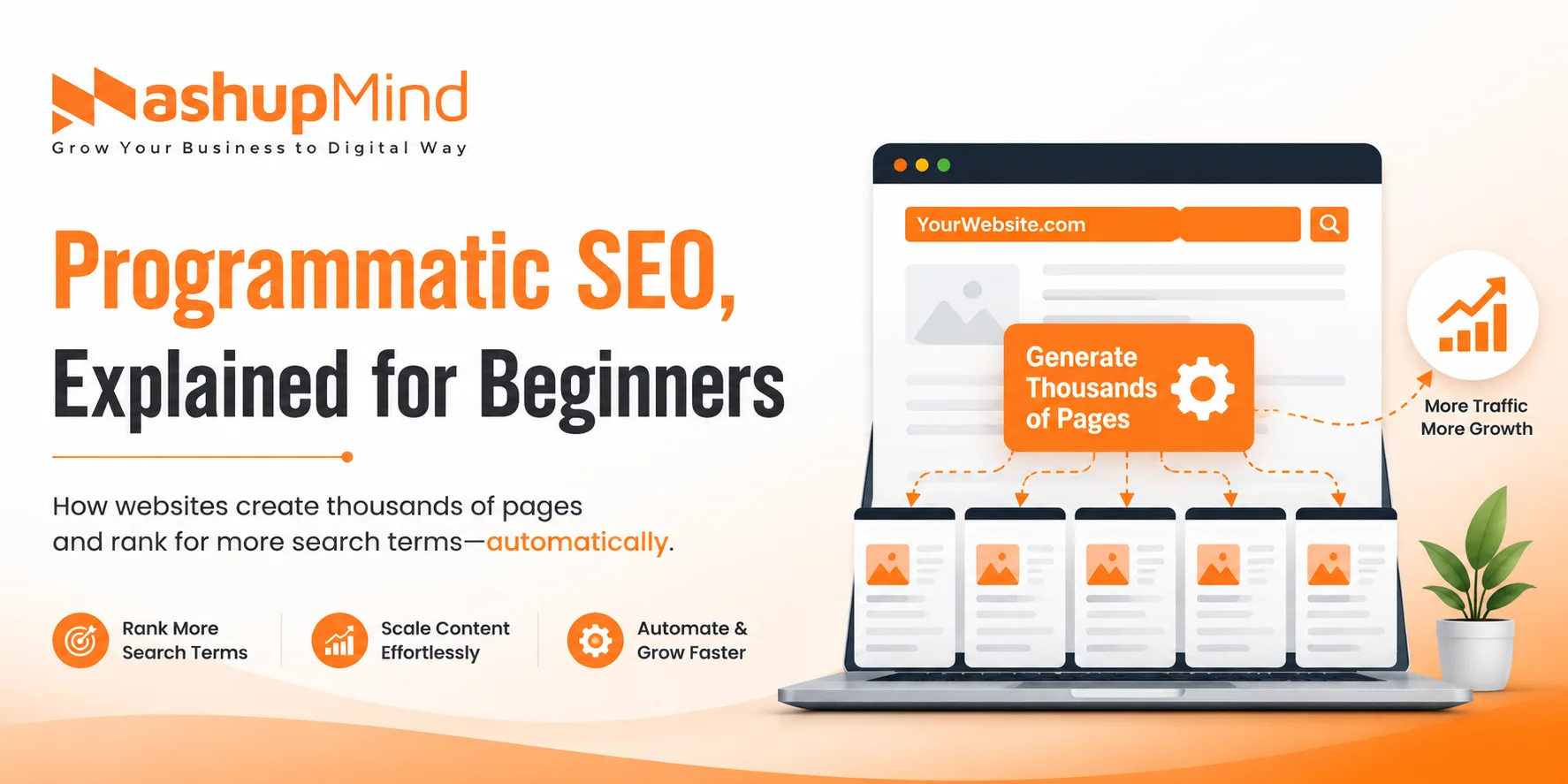
Programmatic SEO is the process of creating and publishing large numbers of web pages using templates, structured data, databases, and automation. Rather than designing and writing every page individually, a company creates a reusable page framework that can pull in relevant information and generate unique pages for different search queries.
For example, a website could create individual pages for different locations, products, services, comparisons, or industries using the same underlying template while changing the information displayed on each page.
Why Is Everyone Talking About It in 2026?
Organic competition has become much tougher. Most brands want to reach more search queries without increasing their content production costs at the same rate.
That’s where scalable page creation can help. When implemented properly, it allows websites to target a large number of relevant long-tail searches while keeping the publishing process more efficient.
Some of the strongest examples in 2026 come from businesses creating location pages, comparison pages, product databases, and industry-specific resources at scale. The key, however, is making sure these pages provide genuine value rather than simply generating hundreds of near-identical URLs.
How Do Websites Generate Thousands of Pages Automatically?
It normally starts with some kind of database that holds structured information, like cities, products, services, or job listings. Then a page template is built, and the site merges the template with that data on its own, pretty much each time.
For example, a hotel directory website might use one template and then automatically create pages for hundreds of cities without manually writing each one.
Examples of Websites Using Programmatic SEO
Some of the most popular SEO examples are things like travel platforms, job boards, online marketplaces, and even software companies, sometimes.
These sites end up producing thousands of pages for particular searches, and as a result, they can pull in a huge amount of organic traffic from search engines.
What is the difference between programmatic SEO and SEO?
Traditional SEO mostly means making individual pages by hand. Each blog entry, landing page, or service page is researched, written, refined, and then published separately, no big shortcuts.
Programmatic works a bit differently. Instead of crafting pages one-by-one, it leans on automation plus templates to crank out pages at scale. This tends to fit websites that go after lots of keyword clusters, all at once.
How it works
A website collects structured data, sets up a reusable template, and then generates pages automatically using keyword variations.
For example:
- Hotels in New York,
- Hotels in Los Angeles
- Hotels in Chicago
Instead of manually putting together thousands of pages, the website uses one template and fills it with location-focused information.
Benefits and Limitations
The main advantage of programmatic SEO for beginners is scalability. With one template, you can generate hundreds or even thousands of pages aimed at distinct search terms, kinda efficiently.
Still, automation alone isn’t enough. If the pages feel thin, have near-duplicate content, or create a rough user experience, they might have a hard time ranking. In the end, success comes from balancing scale with quality, not just volume.
How Does It Work?
Well, it’s kind of like a few steps in a crude sense; five turns is the polished version of it.
1) Collect Data
You gather and combine information that has a structure, such as the names of cities, information about products or services, pricing, and listings; you get the idea.
2) Generate Multiple Pages
From then on, it’s all automated, though it might get a bit tedious with pages rotated for various sets of keywords, variations and combinations.
3) Optimise for SEO
You still need to include optimized titles, meta descriptions, internal links, and relevant content. Otherwise, the pages may look AI-generated and struggle to rank well in search results. Strong on-page SEO remains essential for success.”
4) Publish at Scale
Eventually, you are pushing out a ton of pages super-fast, hundreds or thousands, at the speed of the machine; no human in the mix.
5) Simple Workflow
Collect Data, Create Template, Generate Pages, Optimise SEO and then Publish at Scale.
Real-World Examples of Programmatic SEO
A couple of larger websites essentially constructed momentum by way of this sort of programmatic SEO, at the very least on an imaginative level or certainly according to an institutionalised technique.
- The fundamental unit of the Zapier pages is an app pairing and automation workflow.
- Canva creates “page sets” for the following template types, design themes and creative use scenarios.
- Tripadvisor spin-up pages are related to facilities, trips, and information on hotels.
- Indeed creates resumes of the work-related pages within sectors and in areas, repeatedly.
In brief, these are some of the ways to enjoy a huge boost of targeted traffic and retain considerable consistency in user experience.
Benefits
- Thousands of long-tail phrases that humans could not realistically possibly be covering one by one are what you go after.
- Quick Content Generation: If content is being created in bulk rather than line-by-line day by day, this will be a lot quicker.
- Reduce Content Costs: Saves on lots of handwork and iterative drawing; essentially, less labour and more throughput.
- Improved Keyword Coverage: Reaching varying vistas of search intent, which results in more display in searches.
Risks and Challenges
Many nuances of programmatic SEO just don’t work, you know, and oftentimes, it’s not apparent on the front end.
Common issues are like:
- Courtesy website pages focusing on pretty similar keywords
- Google quality updates that disrupt low-value pages to fall out of tune.
- Indexing issues, particularly on large sites with many URL’s.
- If you are having too much automation or perhaps too much template mimicking, users will likely get a poor UX from you.
It appears that useful pages – ones which help people – are the best kind of programmatic seo technique. Not simply spamming copies at scale like a factory!
Why Do Many Programmatic SEO Projects Fail?
Thin content (ie kind of empty pages).
Many sites develop hundreds of pages, but there isn’t much really worthwhile information inside. If they’re not pages that will very clearly help somebody, they won’t achieve good results in the search results, simple.
The same vibes at different sites (URLs) are a duplicate.
At times, the design keeps using the template in the same manner. Thus, the pages would be almost identical, with the only difference being the changed small placeholders. It creates doubt for search engines when it comes to indexing, or they don’t rank them as highly.
A search query doesn’t match the content of the website.
Choosing a keyword is not the specific and whole task. The page needs to address what it is people are trying to do. If it doesn’t, then visitors are quick to leave, and engagement is low.
Chasing volume NOT value
Though thousands of pages sounds great, it doesn’t imply traffic. Scale + quality, maintaining a user-first and meaningful content are the stronger of the two SEO approaches.
Programmatic SEO vs Traditional SEO
| Feature | Traditional SEO | Programmatic SEO |
| Content Creation | Manual | Automated |
| Scale | Limited | Massive |
| Cost | High | Lower |
| Speed | Slow | Fast |
| Best For | Authority Content | Long-tail Pages |
Traditional SEO is ideal for website content that is deep and informative, how-to content, and thought leadership pieces in which you’re trying to get better with the passage of time. It is all about creating many pages, writing for any long-tail keywords and doing it fast.
Mature, successful businesses don’t necessarily select just one option, either. They mix them up and put them together. These are the trust signals that are generated by the traditional SEO process, which has the ability to record thousands of specific search questions with the help of programmatic SEO.
Best Use Cases for Programmatic SEO
SaaS Websites
For SaaS companies, there may be dozens of use cases, industries, and integrations that they aim at. With this, they build pages like CRM for Realtors or CRM for Dentists or Slack integration with Salesforce without having to create each individual page. This assists in reaching highly targeted audiences looking for certain solutions that software companies can supply.
Job Boards
Job sites have natural structure, which makes them great to apply programmatic SEO. They can automatically generate pages for positions, companies, and areas. These can be such as “Marketing Jobs in New York” or “Remote Finance Jobs. In this way, job boards can generate rankings for thousands of search queries at once.
Real Estate Websites
Real estate websites can create location-specific pages like “Homes for Sale in Miami” or “Apartments in Austin. People usually look for properties by address, so these websites can cover a wide range of search combinations effectively by utilising programmatic SEO.
Travel Websites
By far the most popular programmatic SEO client is travel companies. They develop pages for search terms, such as “Hotels in Paris” or “Hotels in Tokyo” or “Things to do in Bali. These pages are part of an effort to attract people who are at each step in the process of making travel plans.
E-commerce Websites
It is usually used by online stores for category, product, and collection pages. That way, they can optimise their web content for a broader spectrum of potential search queries and attract customers who can more easily discover their products.
Tools Needed for Programmatic SEO
Google Sheets
A complete programmatic SEO project can start from Google Sheets. It assists in structuring keywords, locations, products and much more that will be utilised later on to develop pages.
Airtable
Airtable is far more flexible and also deals well with handling big data sets when compared with the standard spreadsheet program. Numerous businesses employ it as their content database for their programmatic SEO in the formation.
Webflow
Webflow enables visitors to develop damning websites and generate pages based on a group of structured information. Great for teams, especially those that would prefer to pick something that does not require coding or minimal coding.
WordPress
Programmatic SEO WordPress setups are highly sought after as WordPress is flexible and has plugins and automation. Beginners can design their SEO system at a scalable level with the assistance of appropriate tools and procedures.
Ahrefs
Out of all the tools that come when working with programmatic SEO, Ahrefs ranks among the most valuable tools. It helps in finding keyword opportunities, competitor analysis, and locating long-tail keywords worth optimisation.
What is an example of programmatic SEO?
Suppose your focus keyword pattern is:
“Best CRM for [Industry]
No longer do you have to write dozens of articles; you just make one page template.
The template might then be able to create pages like:
- Top CRM Software for dentists
- The best CRM for realtors.
- The best CRM for Lawyers
- Best CRM for Consultants
The information for each page is the same but with industry-specific information, examples and recommendations. This can be replicated across 100 industries to produce our 100s of targeted pages based on one framework.
This is a basic illustration that is one of the easiest to understand what is programmatic SEO and why it is so popular.
How to learn programmatic SEO?
1) Create Unique Content for Each Page
Don’t build pages by just swapping out keywords. Be sure to provide something unique on each page in terms of insights, examples or data that will be of real value.
2) Concentrate on Search Intent.
The key to successful programmatic SEO is getting an understanding of what the user wants. Design web pages to satisfy their needs and address their questions.
3) Use Original Data
Statistics, research, or proprietary information help innovate your page from other SEO examples.
4) Strengthen Internal Linking
Use links on internal pages to navigate your website, enhance the user experience and make things easier for the search engines to find and crawl.
5) Develop the proper programmatic SEO tools.
Programmatic SEO WordPress solutions, along with platforms such as Google Sheets, Ahrefs, as well as Airtable, can aid in automating web page manufacturing while guaranteeing top quality.
Common Mistakes Beginners Make
Publishing Low-Quality Pages
A lot of people think more in terms of how many times they click on Google+ than how good they can make it. One of the quickest methods to fail programmatic search engine optimisation is to go ahead and publish thousands of skinny pages.
Targeting the Wrong Keywords
One of the mistakes that beginners make in developing a programmatic plan is developing pages for keywords that are not in search demand or have little demand. Remember to test the keywords before using them on a large scale.
Ignoring User Experience
The right programmatic SEO services cannot compensate for slow, confusing and hard-to-navigate pages.
Creating Duplicate Content
Having the same content on hundreds of pages can have a negative impact on ranking. Goal-achieving programmatic SEO instances contain singular info on every web page.
Not Checking Indexing
Without being indexed by Google, your pages won’t generate traffic. Check for the technical indicators and indexing performance frequently.
Is Programmatic SEO Still Worth It in 2026?
Yes. In today’s era of AI-generated content, programmatic SEO is still among the most efficient methods for scaling to target long-tail keywords.
Now, more than ever before, Google rewards helpful content that’s focused on their users. This translates to the programmatic SEO best practices (2026) that feature automation, new content, original information, and a positive user experience.
The key to the future is sites that have a combination of quality and scale. Writing a programmatic SEO plan the right way will enable year after year of steady organic boost.
Conclusion
Once you understand how programmatic SEO works, it becomes easier to see why so many companies are adopting it. From SaaS businesses and job boards to travel and e-commerce websites, this approach can help target thousands of relevant search opportunities without creating every page manually.
The key is to use the right tools, understand search intent, and focus on quality rather than simply producing more pages. When done properly, programmatic SEO can become a valuable long-term growth channel in 2026 and beyond.

Mahima is a Content Strategist and Freelance Writer specializing in creating engaging, SEO-driven content across multiple niches. She writes on business, technology, marketing, lifestyle, health, and education, helping brands connect with their audiences through clear and impactful storytelling. Her focus is on delivering well-researched, value-driven content that enhances visibility, engagement, and brand authority.