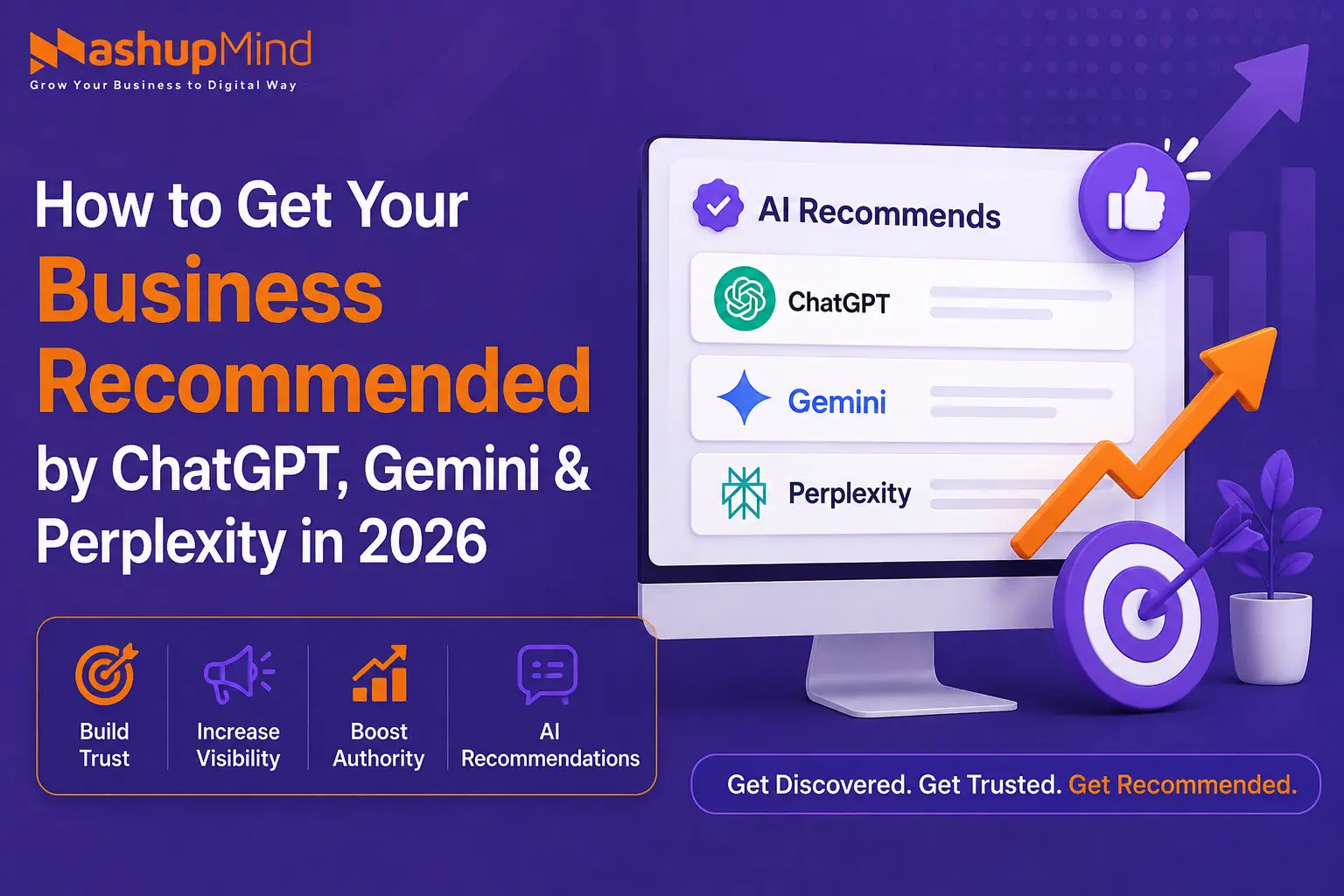
When people need a product, service, software, agency, restaurant, or local business, they are no longer relying exclusively on traditional Google search. Increasingly, they are asking AI platforms questions such as “What is the best digital marketing agency for a small business?” or “Which SEO agency should I hire?” and expecting a short list of useful recommendations.
That shift creates a new digital marketing opportunity: getting your business discovered, understood, and potentially recommended by AI-powered search experiences such as ChatGPT, Gemini, and Perplexity. Unlike traditional search rankings, however, there is no simple formula that guarantees your company will appear in an AI-generated recommendation.
The goal is therefore not to “trick” an AI system into mentioning your company. It is to build a strong, trustworthy, consistent online presence that makes your business easy for search engines and AI systems to understand, verify, and associate with the services you provide.
This guide explains how businesses can improve their chances of being discovered and recommended across AI-powered search in 2026.
What Does It Mean to Be Recommended by AI Search?
AI recommendation visibility happens when an AI-powered search experience identifies your business as a relevant answer to a user’s question.
For example, someone might ask:
- “What are the best digital marketing agencies for small businesses?”
- “Which SEO agency specializes in SaaS?”
- “Who can help my business with local SEO?”
- “What are the best agencies for Google Ads management?”
- “Which digital marketing agency should I consider in Ahmedabad?”
Depending on the query, location, available information, and the system’s search process, an AI platform may mention businesses, summarize their services, compare options, or provide links to supporting sources.
ChatGPT Search can search the web and provide responses with citations and links to relevant sources. OpenAI also states that there is no guaranteed way to secure top placement in ChatGPT Search; allowing OAI-Searchbot to crawl your site is one important eligibility consideration.
Perplexity similarly describes itself as an AI-powered search engine that searches the web and provides conversational answers backed by citations and links to original sources.
This means AI visibility is closely connected to something businesses have already been working toward for years: being a credible, discoverable, and well-described entity across the web.
AI Recommendations Are Not the Same as Traditional Google Rankings
Traditional SEO generally focuses on earning visibility for specific searches and keywords.
AI search is more conversational.
A user may not search:
“best SaaS link building agency”
Instead, they might ask:
“I run a B2B SaaS company and need an agency that can build authoritative backlinks. What agencies should I consider?”
The second query contains more context, intent, and constraints.
That means businesses should think beyond individual keywords and build content and online signals around topics, expertise, services, audiences, locations, problems, and outcomes.
Google’s own guidance is useful here. Google says its AI features continue to rely on foundational SEO practices and that there are no additional special technical requirements specifically required for appearing in AI Overviews or AI Mode. Pages must meet normal technical requirements and be eligible to appear in Google Search.
In other words, AI search does not eliminate SEO. It makes a strong SEO foundation even more useful.
1. Build a Clear Business Entity
Before an AI system can confidently recommend your business, it needs to understand what your business actually is.
Your website should make these facts obvious:
- Business name
- Core services
- Main industries served
- Geographic markets
- Target customers
- Areas of expertise
- Contact information
- Company history
- Team or leadership information
- Relevant credentials
- Case studies and results
- Clear service pages
Avoid making your homepage a vague collection of marketing slogans.
Instead of simply saying:
“We help brands unlock digital growth.”
Explain exactly what you do:
“MashupMind provides SEO, digital marketing, link building, and AI search visibility services for businesses looking to increase qualified organic traffic and online visibility.”
The more clearly your business is described, the easier it becomes for users and search systems to understand your positioning.
2. Make Your Website the Source of Truth
Your website should be the central source of accurate information about your company.
Make sure your business name, services, locations, contact information, and positioning are consistent across important pages.
Create dedicated pages for your major services instead of placing everything on one page.
For example, if you offer:
- SEO
- Local SEO
- Digital marketing
- Google Ads
- Link building
- GEO or AI search optimization
each major service should have a useful page that explains what you provide, who it is for, how the process works, and what customers can expect.
Your existing digital marketing strategy guide can support this broader content structure, while your Google Business Profile optimization guide is relevant for businesses with local visibility goals.
3. Publish Content That Demonstrates Real Expertise
One of the strongest ways to improve your online authority is to consistently publish useful content around your area of expertise.
But publishing dozens of generic AI-written articles is not the objective.
Create content that answers the questions your potential customers actually ask.
For a digital marketing agency, that might include:
- How much does SEO cost?
- How long does SEO take to produce results?
- What should a business expect from a link building campaign?
- How can a local business improve visibility?
- How does AI search affect SEO?
- How can SaaS companies improve organic visibility?
- How should businesses measure SEO ROI?
Your existing SEO content audit guide can help identify content gaps and opportunities before you start producing more articles.
The key is depth over volume.
A website with 30 highly useful resources covering one clear area of expertise can be more strategically valuable than a website with 300 disconnected articles.
4. Answer Conversational Questions Directly
AI search is naturally conversational, so your content should address questions in a conversational way.
Instead of creating an article that repeatedly targets a keyword, structure sections around the questions your audience is likely to ask.
For example:
How Can a Small Business Appear in AI Search?
Start with a direct answer, then explain the supporting strategy.
Does SEO Help With AI Search Visibility?
Answer the question clearly before expanding into technical details.
How Can a Business Become More Trustworthy to AI Search Systems?
Explain the role of consistent business information, authoritative content, mentions, reviews, and relevant third-party sources.
This structure makes content easier for humans to scan and easier for search systems to interpret.
5. Strengthen Your Brand’s Digital Footprint
Your website is important, but your website is not the entire internet.
A business can build stronger recognition when its name, services, expertise, and reputation appear consistently across relevant third-party sources.
Potential sources include:
- Industry publications
- Business directories
- Professional organizations
- Relevant review platforms
- Local business profiles
- Interviews
- Podcasts
- News coverage
- Industry communities
- Authoritative partner websites
- Legitimate guest contributions
The objective isn’t to create hundreds of low-quality mentions.
It is to develop relevant, credible, and natural brand references.
Your existing brand monitoring guide is useful here because monitoring how your business is represented online can help uncover inaccurate information, new mentions, and reputation opportunities.
6. Earn Relevant Backlinks, Not Just More Backlinks
Backlinks remain an important part of online authority, but quantity alone is not a strong strategy.
A relevant mention from a respected industry publication can be far more meaningful than dozens of unrelated links.
Focus on:
- Topical relevance
- Editorial context
- Website quality
- Natural anchor text
- Genuine relationships
- Useful contributions
- Strong destination pages
MashupMind already has extensive resources on link building, broken link building, and link reclamation, so businesses can use those strategies as part of a broader authority-building campaign.
The important distinction is that link building should support your reputation rather than exist purely as a numbers game.
7. Build Strong Local Signals for Local Recommendations
If you operate a local business, location can dramatically change the relevance of a recommendation.
A business serving customers in Ahmedabad, for example, should make its location and service area clear across its website and important business profiles.
Make sure your business information is consistent, including:
- Business name
- Address
- Phone number
- Website
- Opening hours
- Service areas
- Business category
- Services offered
Also build useful location-specific pages when they genuinely help customers.
Google’s AI search guidance emphasizes the continued importance of foundational SEO and making content useful and reliable.
For additional context, see MashupMind’s local SEO strategies for small businesses and how local search results change by region.
8. Keep Your Business Information Consistent Everywhere
Imagine your website says your company provides SEO and Google Ads services, while a business directory says you are primarily a web design company.
Another profile lists a different address.
A third profile uses an old phone number.
This creates unnecessary ambiguity.
Review important business profiles and make sure the following information is aligned:
- Business name
- Website URL
- Contact information
- Address
- Services
- Company description
- Founding information
- Areas served
- Industry positioning
Consistency does not mean copying exactly the same paragraph everywhere. It means making sure the underlying facts are accurate and consistent.
9. Create Original Data and First-Hand Insights
This is one of the best ways to differentiate your website from generic content.
Instead of only explaining what everyone else already knows, publish information based on your own experience.
Examples include:
- Original case studies
- Campaign results
- SEO experiments
- Before-and-after comparisons
- Industry surveys
- Client success stories
- Original statistics
- Expert interviews
- Process breakdowns
- Real examples of mistakes and fixes
For example, instead of writing another generic article about SEO audits, an agency could publish:
“We Audited 100 Small Business Websites: Here Are the 12 Issues We Found Most Often”
That type of content has a much stronger reason to exist.
10. Use Structured Data Where It Makes Sense
Structured data can help search engines understand specific information about your pages and organization.
Depending on your website, relevant schema types may include:
- Organization
- LocalBusiness
- Article
- BreadcrumbList
- Service
- Person
- Product
- FAQPage, where appropriate
Structured data should accurately represent visible page content. It should never be used to claim information that isn’t actually supported on the page.
Think of schema as a way to improve machine-readable understanding—not a shortcut to AI recommendations.
11. Make Your Content Easy to Verify
AI search systems often provide citations or links to supporting sources.
ChatGPT Search can show citations to sources used in responses, while Perplexity describes its answers as being backed by citations and links to original sources.
That makes credibility increasingly important.
When making factual or data-driven claims:
- Cite authoritative sources.
- Link to original research when appropriate.
- Avoid unsupported statistics.
- Update outdated claims.
- Identify authors where relevant.
- Explain methodology for original research.
- Separate opinions from facts.
Your content should be something a reader can independently verify.
12. Build Author and Expert Credibility
If your company publishes expert content, make it clear who is behind that content.
Consider adding:
- Author name
- Author bio
- Professional experience
- Areas of expertise
- Relevant credentials
- Company affiliation
- Links to professional profiles when appropriate
This is particularly useful for subjects where experience and trust matter.
The goal isn’t to manufacture authority. It is to make genuine expertise visible.
13. Don’t Ignore Traditional SEO
One of the biggest mistakes businesses can make is assuming that GEO or AI search optimization means traditional SEO no longer matters.
It doesn’t.
Google explicitly states that its existing SEO best practices remain relevant to AI features such as AI Overviews and AI Mode.
Continue to focus on:
- Crawlability
- Indexability
- Search intent
- Helpful content
- Page experience
- Internal linking
- Site architecture
- Relevant keywords
- Clear headings
- Descriptive titles
- Quality backlinks
- Technical SEO
MashupMind’s technical SEO guide and on-page SEO guide provide useful foundations for these areas.
14. Make Internal Linking Part of Your AI Visibility Strategy
Internal links help users discover related information and help search engines understand how your website’s pages relate to one another.
For example, an agency could connect:
Digital Marketing → SEO → Local SEO → AI Search → Link Building → Content Strategy
This creates topical relationships instead of leaving individual articles isolated.
For MashupMind, this article can naturally connect to existing resources covering:
- SEO to GEO, AEO, AIO and LLMO
- B2B SEO and AI/LLM visibility
- SaaS visibility in ChatGPT, Gemini and Perplexity
- Google Business Profile optimization
- SEO content audits
- SEO automation tools
This also gives readers a natural path to explore deeper topics.
15. Optimize for the Questions Your Customers Actually Ask
A business should not build an AI visibility strategy around vanity queries alone.
Think about the questions prospects ask before hiring you.
For a marketing agency, these could include:
“Who can help a small business improve Google visibility?”
“What is the best SEO agency for a SaaS company?”
“How much should I spend on SEO?”
“Should I hire an SEO agency or do SEO in-house?”
“How can I get my company mentioned in AI search?”
These questions can become:
- Blog posts
- FAQs
- Service-page sections
- Comparison pages
- Case studies
- Guides
- Videos
- Expert interviews
This creates a content ecosystem around real customer intent.
16. Monitor AI Visibility Instead of Assuming You’re Visible
AI recommendations can change.
A company mentioned today may not appear for the same query tomorrow.
Different users can also receive different results based on factors such as query wording, location, context, available sources, and the AI system’s retrieval process.
Therefore, treat AI visibility as an ongoing measurement process.
Create a list of relevant prompts and periodically test them across:
- ChatGPT
- Gemini
- Perplexity
- Google AI search experiences
Track:
- Whether your business appears
- Which competitors appear
- How your business is described
- Which sources are cited
- Whether the information is accurate
- Which pages or third-party sources support the recommendation
- Which gaps you need to address
Don’t treat one successful mention as proof that you’ve “ranked in ChatGPT.”
AI search is dynamic, and there is no universal position #1 that can be guaranteed.
17. Fix Negative or Inaccurate Brand Information
Sometimes the biggest problem isn’t lack of visibility.
It is incorrect visibility.
An AI-generated answer may contain outdated information about your company, services, location, leadership, or products because information on the web is inconsistent or outdated.
Regularly monitor your brand presence and correct important inaccuracies at their original sources where possible.
Also watch for:
- Outdated business profiles
- Incorrect addresses
- Old service descriptions
- Duplicate business listings
- Misleading third-party pages
- Incorrect company names
- Outdated team information
A strong online reputation strategy should therefore become part of your broader AI visibility strategy.
A Practical 30-Day AI Visibility Plan
You don’t need to overhaul your entire marketing strategy overnight.
Use this simple 30-day framework.
Week 1: Establish Your Foundation
Audit your website and confirm:
- Business name is consistent
- Services are clearly defined
- Location and service areas are accurate
- About page is complete
- Contact information is correct
- Important service pages exist
- Technical SEO issues are addressed
Week 2: Strengthen Your Content
Identify the 10–20 questions your prospects ask most often.
Create or improve content that answers those questions directly.
Prioritize expertise, originality, evidence, and usefulness over keyword repetition.
Week 3: Improve Your Digital Footprint
Review:
- Google Business Profile
- Business directories
- Industry profiles
- Social profiles
- Review platforms
- Partner websites
- Existing brand mentions
Correct inconsistent information and identify legitimate authority-building opportunities.
Week 4: Start Measuring AI Visibility
Create a prompt set relevant to your business.
For example:
- “Best [service] agencies for small businesses”
- “Best [service] company in [city]”
- “[service] agencies for SaaS companies”
- “Who can help with [specific problem]?”
- “Compare the best [service] providers for [audience]”
Run these searches periodically and document the results.
The goal isn’t to force an AI system to mention you. The goal is to understand why some businesses are being surfaced and what credible signals support those recommendations.
Common Mistakes to Avoid
Keyword Stuffing
Repeating “best SEO agency” dozens of times won’t make an AI system trust your business.
Fake Reviews
Artificial reviews can damage trust and create reputation problems.
Low-Quality Backlinks
Hundreds of irrelevant links are not a substitute for genuine authority.
Publishing Generic AI Content at Scale
AI can help with research and drafting, but generic content without original insight gives users little reason to choose your site.
Making Unsupported Claims
Don’t call your company “the #1 agency” unless you have legitimate evidence supporting that statement.
Ignoring Technical SEO
If important pages aren’t crawlable or indexable, your content cannot perform as intended.
Treating AI Search Like a Traditional Ranking System
There is no universal AI search ranking position you can guarantee.
Creating Content Only for AI
The ultimate audience is still people. If your content is difficult, repetitive, or unhelpful for humans, it is unlikely to build a strong business reputation.
Final Thoughts
Getting your business recommended by ChatGPT, Gemini, or Perplexity isn’t about discovering a secret prompt, manipulating an AI model, or publishing hundreds of pages overnight.
It’s about becoming the kind of business that has a strong digital footprint, clear expertise, consistent information, useful content, legitimate authority, and a reputation that can be verified across multiple sources.
AI search is also evolving quickly. ChatGPT Search can retrieve current information from the web and cite sources, while Perplexity similarly emphasizes real-time web information and source citations. Google, meanwhile, says its AI search features continue to rely on foundational SEO practices rather than requiring a separate set of special technical optimizations.
So don’t abandon SEO for GEO. Build on SEO, strengthen your brand entity, publish genuinely useful expertise, earn relevant authority, maintain accurate business information, and continuously measure how your brand is represented across AI-powered search.
That is the sustainable path to becoming a business that AI systems can confidently discover, understand, cite, and potentially recommend.

Harsh Mistri is a Digital Marketing Executive with over 8 years of experience in SEO, online marketing, and growth strategies. He is passionate about exploring the evolving digital landscape and enjoys writing about technology, SEO, and digital marketing.