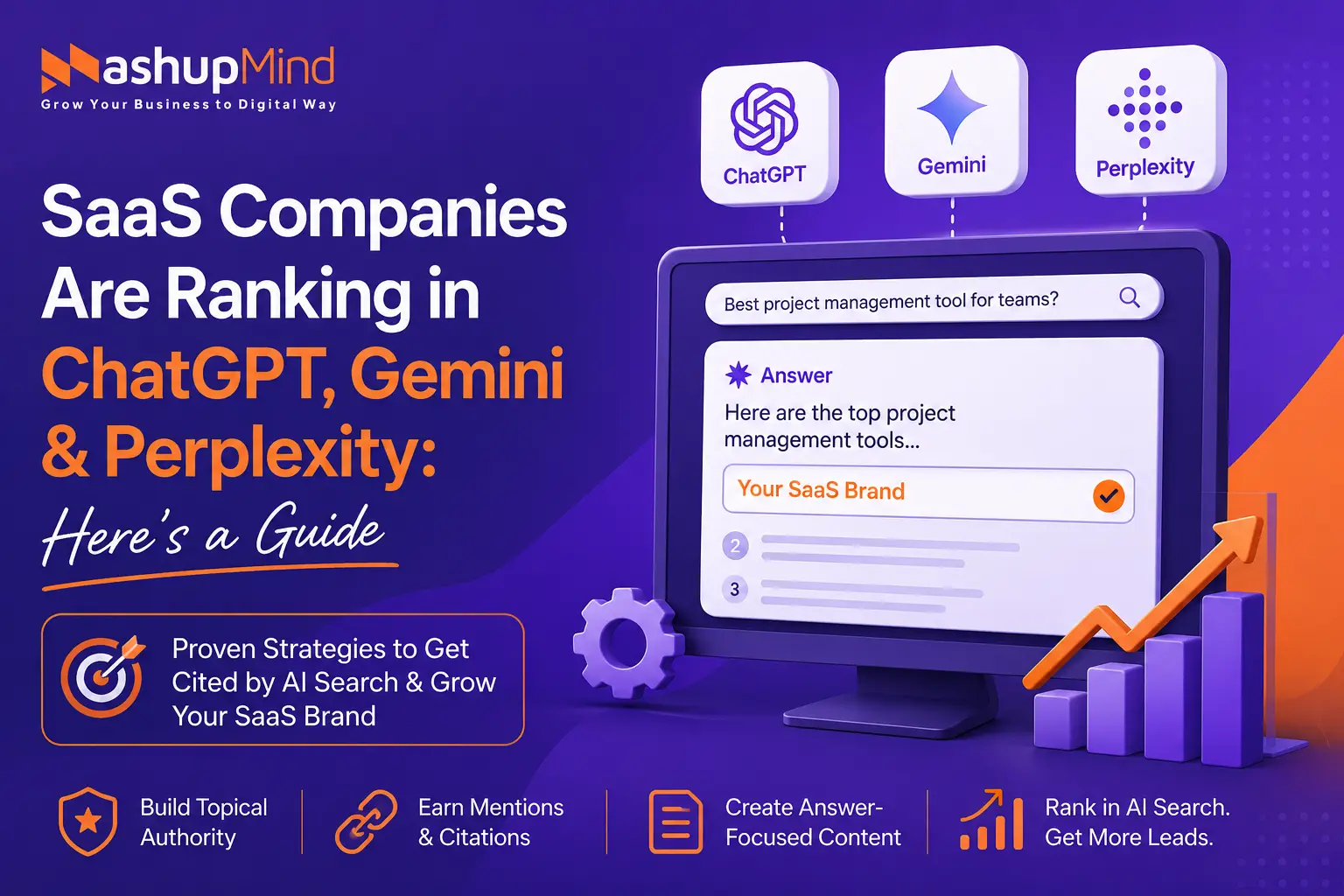
There are now different rules for searching. In this day and age of AI-made answers, here’s how to win.
SEO only meant one thing for more than 20 years: getting on Google’s blue links. Businesses that offer SaaS spent a lot of money on things like backlinks, meta tags, and keyword density to show up on the first page of search results, where people would then scroll down and read more.
That model is breaking.
More and more buyers today never click on any search results at all. Their question is: What project management tool should they use? They ask Perplexity to look at different CRM prices. So, they ask Gemini to suggest a platform for analytics. And the AI answers, most of the time without sending anyone to your website.
That buyer doesn’t know about your SaaS brand if it’s not mentioned in those answers.
Generative Engine Optimization (GEO) is the new field that studies how to make your content, brand, and online presence rank higher in AI-generated results. The steps that SaaS companies can take to do it are laid out in this guide.
Why Traditional SEO Is No Longer Enough
Google is still important. Traffic still comes from organic search. But the layer of user behavior on top of it has changed in a fundamental way.
Estimates from the business world say that AI-powered search tools now handle hundreds of millions of queries every day. Most of the queries that go to ChatGPT, Gemini, and Perplexity are high-intent and decision-stage, which are the exact searches that SaaS companies need to be in.
It’s not research mode for someone to type “best HR software for remote teams” into Perplexity. They’re almost ready to make a choice. If your product isn’t in Perplexity’s answer, that lead is gone before it even gets to your funnel.
In the old days, SEO was all about signals like keyword match, domain authority, and backlink profiles. GEO isn’t the same for SaaS. It has to do with being cited, believed, and put together by big language models that want to give the best, most accurate answer they can.
How AI Search Engines Actually Work (and Why It Matters for GEO)
You need to know how CGT, Gemini, and Perplexity pull and rank information before you can rank in them.
- ChatGPT is able to use both its training data and real-time web retrieval in its browsing-enabled or search-augmented modes. It takes information from different sources and puts it together in a way that makes sense in a conversation. It usually chooses sources that are clear, reliable, and often cited on the web.
- Perplexity is a search engine that is based on AI. It actively retrieves web content in real time and directly cites its sources. It likes structured, factual content that answers questions directly. For content marketers, this makes it the most “optimizable” of the three.
- Gemini is tightly connected to Google’s index and Knowledge Graph. This means that your normal SEO signals, like backlinks, structured data, and E-E-A-T, are given a lot of weight here. YouTube, Google Business, and featured snippets are some of the Google services that Gemini uses. This makes those channels more important than ever.
What all three systems have in common is that they value authority, clarity, and the ability to be cited. That’s what SaaS AI Search Optimization is based on.
7 GEO Strategies SaaS Companies Must Implement Now
Now is the time for SaaS companies to use these 7 GEO strategies:
1. Own the Answer for Your Category
AI programs are trying to figure things out. It’s your job to make sure that your content is the best answer to the questions that people are asking.
Make a list of the questions your ICP asks at each stage of the funnel to start. Ask full questions, not keywords. “What is the best SaaS tool for X?” “How does [your type of software] work?” “What should I look for in [your type of product]?”
After that, make sure you have dedicated, complete content that directly answers each question. This answer shouldn’t be buried in a paragraph; it should be in the page’s headline and in the first 100 words. When AI systems come up with answers, they look for this structure.
2. Build Topical Authority, Not Just Keyword Clusters
Topical depth is one of the clearest signs that an AI system uses to figure out how trustworthy someone is. In a way that a single optimized landing page can’t, a site that covers all sides of a subject, from basic explainers to in-depth technical guides, shows that the owner knows what they’re talking about.
If you run a SaaS business, this means making a real content hub around your category. Your website shouldn’t just have product pages if you sell software for customer success. It should also have pages about customer churn, NPS, onboarding, QBRs, health scores, and expansion revenue.
The people who ChatGPT or Perplexity use to put together a response for your category are people who have shown they fully understand the topic. You can become one of those sources by being an expert on the subject.
3. Your name should be linked to all over the web.
Backlinks used to be important for SEO. GEO values citations and mentions, even ones that aren’t linked. When AI models are trained on web data, they learn that a brand is trustworthy if it shows up in a lot of different, reliable places, like industry magazines, analyst reports, comparison websites, podcasts, forums, and review sites.
This means that SaaS companies need to be proactive about how they get earned media. Ask G2, Capterra, and Trustpilot to review you. Try to get coverage in trade publications that focus on your industry. Look for mentions in comparison and list posts. “Best tools for X” roundups are great places to be in AI-generated answers. Show up on podcasts in your area. Write guest posts for reputable websites in your field.
Every mention shows that you are a real, trustworthy player in your field.
4. Optimize for Perplexity SEO with Source-Worthy Content
Perplexity is different because it shows where it comes from. That means you can see what kinds of content it gets its information from and figure out what works.
Perplexity prefers material that is:
- Data points, statistics, and named examples are better than vague claims because they are factual and specific.
- Made it easy to extract information with headers, bullet points, and short paragraphs
- Fresh content is important to Perplexity, so evergreen posts need to be updated often.
- The tone is authoritative, and strong, clear language like “The best approach is X” is more likely to show up than vague, unsure writing.
One useful Perplexity SEO tip is to search for your target questions on the site and look at which pages get cited. Look at their structure, details, and uniqueness. Then make something even better.
5. Leverage Structured Data and Schema Markup
This is mostly important for Gemini SEO, which relies on Google’s organized understanding of the web a lot. Google and Gemini can better understand what your page is about and how it should be categorized when you use schema markup, especially FAQPage, HowTo, Product, and Review schemas.
Companies that use SaaS:
- On price and comparison pages, use the FAQPage schema.
- Add rating and review fields to your product pages using Product schema.
- Make your brand’s identity and credibility signals stronger with Organization schema.
- Add a “How To” schema to tutorials and guides for getting started.
Gemini’s AI Overviews use structured, schema-tagged content a lot. This is easy money that a lot of SaaS companies still don’t take advantage of.
6. Establish Strong E-E-A-T Signals
Experience, Expertise, Authoritativeness, and Trustworthiness are the four things that Google wrote down, but all major AI engines already understand them. LLMs are taught to give more weight to sources that show these traits.
To make E-E-A-T better for SaaS brands, it looks like:
- Every piece of content should have an author bio with credentials, a LinkedIn profile, and examples of their work in the field.
- Surveys, benchmark reports, and private data that can’t be copied by anyone else make up original research.
- Sources that are clear: use your own data and studies from other sources; don’t make claims without proof.
- Customer proof includes case studies, testimonials, and use cases that show how your product has been used in the real world.
- Founder and team visibility through LinkedIn profiles, speaking engagements, and public profiles that make the brand seem more human.
AI models use E-E-A-T signals to decide which answer to show first. These signals stand for “Can I trust this source?”
7. Optimize Your Brand’s Knowledge Graph Presence
A part of ChatGPT SEO that a lot of marketers don’t think about is what the model “knows” about your brand from the data it has been trained on. If your company doesn’t show up much or at all in the data that LLMs were trained on, you’re in a bad position.
Make your knowledge graph presence stronger by:
- Keeping a Wikipedia page up to date (if allowed) or adding to related Wikipedia pages that talk about your category
- Keeping your Google Business Profile, Crunchbase page, and LinkedIn page up to date and full of information
- Putting out press releases through reputable wire services that get indexed on many websites
- Getting coverage in media outlets that are commonly used in training datasets (TechCrunch, Forbes, The Verge, Wired, etc.)
- Just to be clear, your tagline, category description, and value proposition should be the same across all platforms and channels.
A lot of reliable sources must agree with you in order for AI to “know” about your market.
The Bottom Line
SaaS companies that build for how buyers search now, not how they searched five years ago, are the ones that will get the next wave of B2B demand.
GEO for SaaS isn’t the same as SEO. That’s how it changed over time. The basics are still important: trustworthy content, strong brand signals, and technical optimization. But the place we’re going has changed. Now it’s not enough to just get on a results page. You want to be the answer that an AI confidently gives to a buyer who might never even visit your website. Start making your presence known right away. Tomorrow, the companies that do the best job of optimizing for ChatGPT SEO, Perplexity SEO, and Gemini SEO will be at the top of AI-generated search results.

Harsh Mistri is a Digital Marketing Executive with over 8 years of experience in SEO, online marketing, and growth strategies. He is passionate about exploring the evolving digital landscape and enjoys writing about technology, SEO, and digital marketing.