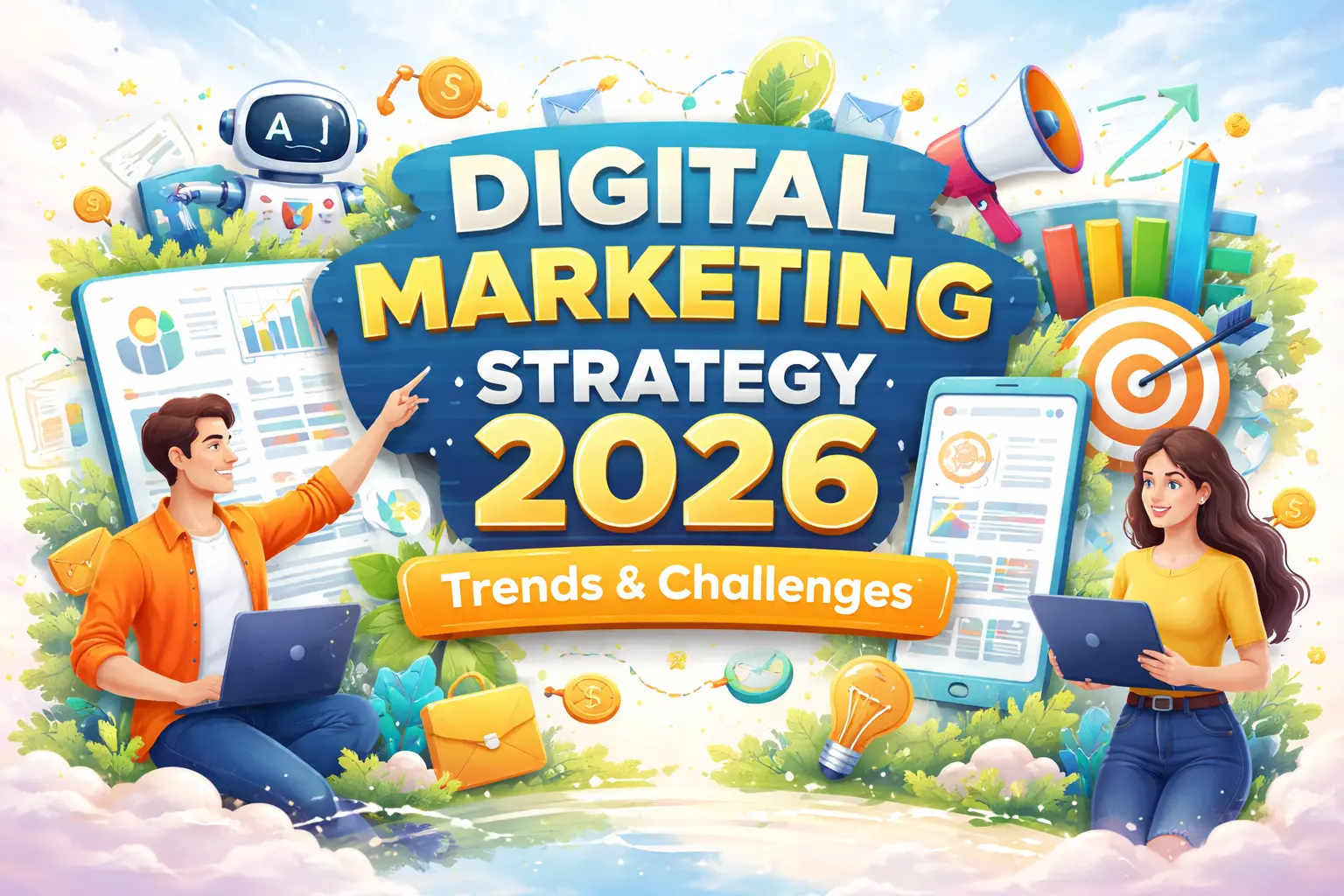
The online business landscape is changing faster than ever. One digital marketing strategy alone won’t be enough anymore in 2026. Brands need to adapt to new technologies and changing user habits. Simply showing up is no longer enough. In fact, it’s the audience trust that brands are chasing.
The online business space is shifting faster than ever. In 2026, there won’t be enough to rely on a single digital marketing strategy. New technologies and changing user habits require brands to adapt. Just showing up no longer cuts it. So indeed, it’s the audience trust that brands are pursuing.
The Shift Toward AI-Powered Marketing
AI is no longer a trend for the distant future. In 2026, it is at the heart of every successful online Marketing strategy. Now, AI tools are available to help businesses predict things customers desire before they even voice a request. This enables hyper-personalization at scale.
- AI Agents: Intelligent bots that can do much more than chat. They can also perform complex tasks, such as making appointments or tracking orders.
- Predictive analytics: Businesses use data to predict whether a specific sale will be successful. This means budgets and stock can be managed more effectively.
- AI support: AI generates points and drafts very quickly. But it’s the human element that maintains the brand voice and makes it distinct.
Key Digital Marketing Challenges in 2026
The tech world might offer new doors for the industry, but it also poses fresh digital marketing challenges. Today, the biggest challenge for most brands is being seen in a crowded space.
-
Data Privacy and the Death of Cookies
Over time, privacy laws around the world have become much stricter. Third-party cookies have largely disappeared. That makes tracking user behavior across sites extremely difficult. Brands went for “first-party data” instead. This is voluntary data that users share, like signing up for your email list or a loyalty program.
-
Content Saturation and “AI Slop.”
The internet is a vast ocean of content. AI can generate text very quickly, leading to a lot of low-quality “slop” on the internet. One of the major challenges in digital marketing is cutting through this noise. This is exhausting users with prosaic counsel. We need real stories and genuine human-specific expertise.
-
Rising Ad Costs
Meta and Google ad rates continue their upward spiral. On the other hand, the ROI is usually far more modest. It is a risky practice in digital marketing when you rely solely on paid ads. Smart companies are spending a lot more on organic growth and community building.
Emerging Trends to Watch
If you want to be successful in 2026, you have to see where the attention is heading. Effective messaging is not just about the tools you use, but also about how you engage with people.
-
Video is Still King
Short-form video is still the most engaging format of all. However, the style is changing. People respond better to “raw” and “behind-the-scenes” clips than super-polished ads. UGC is more trusted than any other content type as it feels genuine.
-
Community-Led Growth
In a bot world, people want human contact. Brands that build private communities on Discord or WhatsApp groups enjoy greater loyalty. These spaces provide direct access to customers in a direct communication environment.
-
Immersive Experiences
AR is rapidly becoming a standard shopping tool. They can also use their phone to “try on” glasses or see how a sofa would look in their living space, for example. It helps lessen buyer remorse and thus lowers return rates.
How to Create a Digital Marketing Strategy
Creating a strategy for 2026 does not need to be complicated. You may follow this simple grid to set the priorities for our work.
Focus Area |
Goal for 2026 |
Key Action |
|---|---|---|
| Data | Build Trust | Focus on first-party data and clear privacy policies. |
| SEO | AI Visibility | Use structured data and answer specific user questions. |
| Social | Engagement | Post short-form videos and build a community. |
| Ads | Efficiency | Use AI to test hundreds of ad variations quickly. |
| Content | Authenticity | Add personal stories and expert insights to every post. |
How to Overcome Marketing Obstacles
To overcome digital marketing challenges at a digital agency, there should be a change in mindset. Focus on the point most important to your audience, rather than trying to cover too much.
- Audit Your Tools: Use AI when it makes sense—employment to solve real-world issues, such as customer service lag and sorting of data.
- Be Human: Highlight the people within your brand. In 2026, people trust people, not logos, so founder-led content is doing really well.
- Be Intent: Target not just keywords, but also understand why the user is searching. New visitors reading for information or new customers willing to purchase?
Conclusion
In 2026, the digital marketing strategy has to be balanced. You need to embrace AI for its speed but retain human creativity for its soul. The ability to be honest, helpful, and agile solves the modern digital marketing challenges. This new age will see the survival of brands that focus on user experience rather than mere clicks.
At Mashup Mind, these shifts are something we deal with every day. Being a full-service digital marketing agency, we focus on combining practical experience with data-driven strategies that actually work. Our work spans across SEO, social media, and advanced AI-led solutions, helping brands navigate the digital space with more clarity and confidence.
Based in India, we collaborate with both startups and established businesses, understanding what each stage of growth really needs. For brands looking to stay relevant in 2026 and beyond, Mashup Mind works as a reliable long-term partner rather than just another service provider.
Frequently Asked Questions (FAQs) –
-
What is the most important part of a digital marketing strategy in 2026?
At its core, the solution is about building a strong first-party data infrastructure. In a world where traditional tracking is dying, knowing who cares about you via email or communities will be key to long-term survival.
-
How can small businesses handle the digital marketing challenges of high ad costs?
Local businesses must focus on niche organic search and community engagement. Grow a loyal audience by creating relevant, high-quality content and avoiding dependence on emerging paid advertising methods.
-
Is SEO still relevant with the rise of AI search tools?
Yes, but it’s different now. SEO is now about being a trustworthy source that AI tools want to cite. Strong on-page SEO, structured content, and real value make a big difference.

Harsh Mistri is a Digital Marketing Executive with over 8 years of experience in SEO, online marketing, and growth strategies. He is passionate about exploring the evolving digital landscape and enjoys writing about technology, SEO, and digital marketing.