The fact that search engine optimization entered the field of the digital world indeed has implications for e-commerce and businesses that best establish themselves before the dawn of seriousness. Undoubtedly, the reverse consequence of growth and success can be felt by any business that underestimated its existence in the first place.
On-page SEO Vs off-page SEO is another debate that has made businesses and marketers ponder their individual skill sets and abilities. In fact, companies looking to strengthen their overall search growth need to utilize both of the enterprise SEO types as they act as the core of SEO’s presence, and the absence of one can significantly damage the website’s overall organic growth journey.
On-Page SEO Vs Off-Page SEO: Which One To Look Out For?
It basically contains all the elements that create a massive search presence for businesses and ensure their websites rank at the top of Search Engine Result Pages (SERPs).
On-Page SEO
On-page Saas SEO services generally include all the materials and content that can be seen by the targeted traffic on their sites. When predicting growth, one-page seo management talks about the quality of content, site structure, and optimization that improves its recognition on Google and Bing search listings.
Off-Page SEO
governs all the background elements of the site and enables search engines to acknowledge it, hence its capability and credibility. This consists of enhancing link-building methodologies for a site and the quantity and quality of guest blogging and linkages with other reputable sites.
Why On-Page and Off-Page SEO Matter for Businesses
Modern businesses use SEO as an essential tool to build better online visibility, which generates natural website traffic. The partnership between on-page and off-page SEO creates better website visibility and credibility, so site visitors can easily discover the products or services.
A website attains effective search engine rankings through on-page SEO Services when it possesses high-quality content, along with quick loading speeds and appropriate keyword distribution that helps search engines comprehend its value. Even websites with superior designs become less effective in reaching their intended customers if basic elements such as SEO components are absent.
The enhancement of website trustworthiness occurs exclusively through off-page SEO by creating both backlinks from external sources and deploying brand mentions across platforms, as well as social signal presence. A website’s serious ranking performance depends on external factors that search engines use to evaluate it; therefore, developing an effective off-page strategy ensures lasting success.
Organizations that unite their on-page SEO with off-page SEO can improve their search engine position while drawing premium visitors, which helps them gain leadership status in advancing digital markets that exist today.
How Search Engines Evaluate On-Page and Off-Page SEO
The evaluation system used by search engines depends on multiple on-page and off-page SEO aspects for website assessment. Digital content evaluation for on-page SEO reviews keyword use and content quality, and meta tags with site structure.
The search engines rank websites that deliver precise content that is detailed, and organized content, and at the same time maintain quick loading times and mobile compatibility. Core Web Vitals measure important aspects of page experience, including loading performance, responsiveness, and visual stability. Good page experience can support a better user experience, although meeting Core Web Vitals thresholds does not guarantee higher rankings.
Off-page SEO focuses on signals that can strengthen a website’s reputation and authority, including relevant backlinks, brand mentions, digital PR, and relationships with reputable websites. While third-party metrics such as Domain Authority can help SEO professionals evaluate link profiles, they are not Google ranking factors.
Search engines give priority to websites that receive high-quality and important backlinks while they assess both linking quality and quantity. The authority of a website is enhanced through public mentions occurring within social media platforms alongside other online channels. The combination of on-page SEO and off-page SEO strategies produces better search rankings while building permanent trustworthiness among search results.
Key Aspects of On-Page SEO Vs Off-Page SEO
On-Page SEO Factors
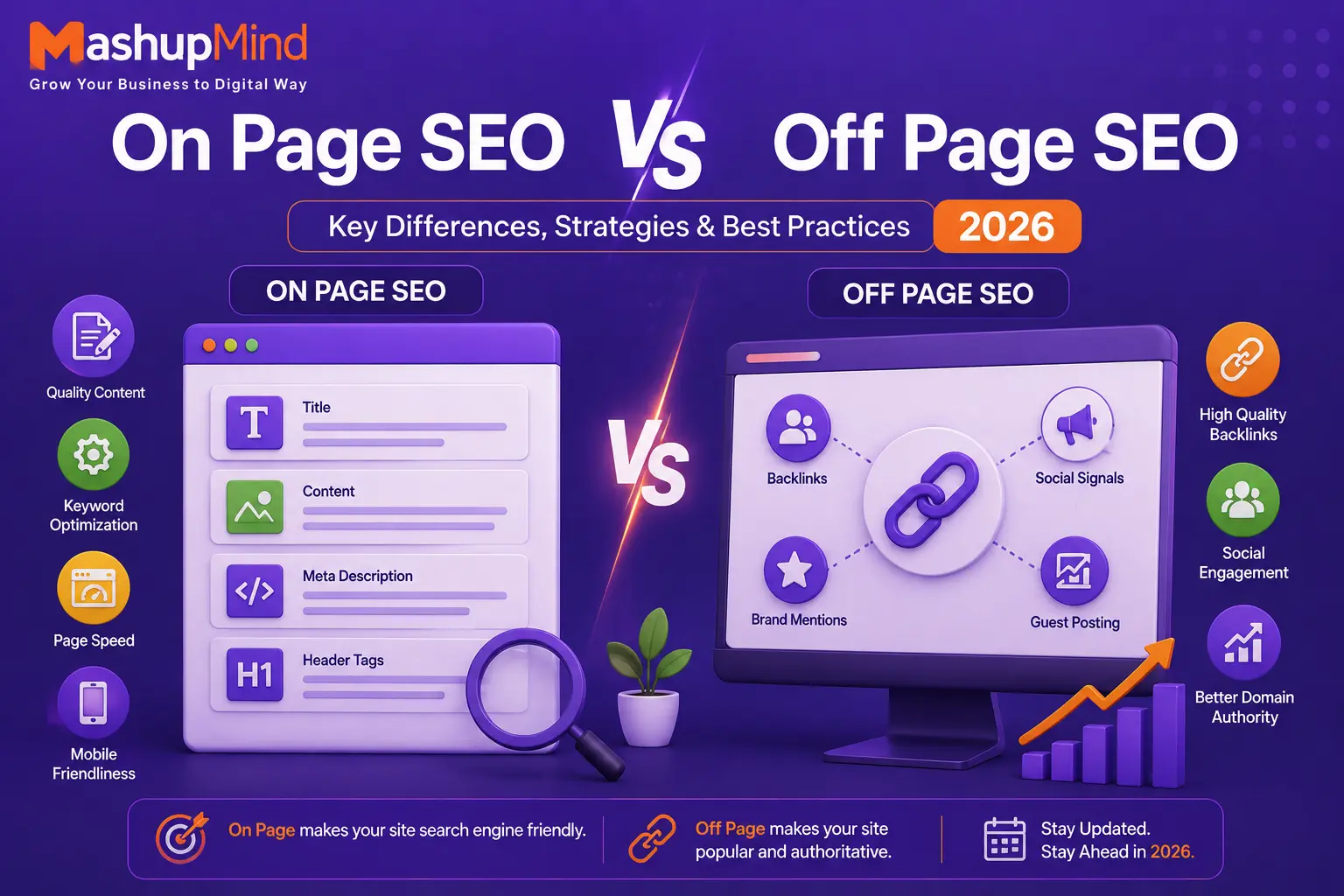
On-page SEO includes several important factors that influence how effectively a website can rank in search results. Some of them include:
-
Page Speed
Page speed is of utmost importance in on-page SEO since it is the very first impression and experience that search prospects will encounter. SEO professionals can improve page speed by optimizing images, reducing unnecessary scripts, enabling browser caching, and working with developers to improve technical performance. Google cares for those sites whose page speed is improving, and they ensure quick results to satisfy Google.
-
Title Tags
A well-written title tag should clearly describe the page and naturally include the primary keyword when relevant. Instead of focusing on a strict character limit, keep the title concise enough to communicate the page’s value without unnecessary wording.
-
Meta Descriptions
A meta description briefly summarizes a webpage and helps users understand what they can expect from the page in search results. It should be clear, relevant to the page content, and written naturally to encourage clicks. Include the primary keyword where it fits naturally, but avoid keyword stuffing. There is no fixed character limit, as Google may truncate or rewrite snippets depending on the device and search query.
-
Content Quality
The content holds the core of any company’s SEO or digital presence. Without proper web content writing, nothing matters regarding title tags, backlinking strategies, or optimized presence because the would-be visitor leaves the site without having their questions answered. Google rewards sites that host informative and educational content to address questions or problems; disregarding aspects like content structure, readability, quality, etc., can counteract a site’s presence in search engines.
-
User Experience (UX)
The essential part of on-page SEO depends on user experience (UX) because it helps websites become more usable and engaging. A website that loads quickly, adjusts to any screen size, and offers clear organization permits users to move easily, thus decreasing page exits and raising visitor duration.
Core Web Vitals help measure important aspects of page experience, including loading performance, responsiveness, and visual stability. A strong user experience can help visitors navigate and interact with a website more easily.A business benefits from prioritized UX by improving search rankings while retaining users through a more effective digital presence.
Off-Page SEO Factors
Some of its essential factors for off-page SEO are as follows:
-
Backlinking Strategies
Backlinks are one of the significant components of off-page SEO, and their quality and quantity define the performance of off-page SEO. Backlinking allows businesses to interact with others and relate their presence within an organization, passing on some content juice from one site to another. Google recommends that businesses implement link-building strategies efficiently and create quality backlinks.
-
Social Media
With regard to popularity and growth, social media marketing is a tool that allows the introduction of an online site to distinct audiences existing on various social media platforms. A brand representative can consistently post content on LinkedIn, thereby making a case for an authoritative presence and attaching its link to social sites. One tremendous advantage of social media is reaching out to a heterogeneous audience and engaging with them.
Social media can support off-page SEO by helping businesses distribute content, increase brand awareness, and reach relevant audiences. While social media activity itself is not a direct Google ranking factor, greater visibility can lead to brand mentions, content discovery, and opportunities to earn relevant backlinks.
Common Mistakes in On-Page and Off-Page SEO
Avoiding common on-page and off-page SEO mistakes is crucial for improving rankings, website credibility, and long-term digital success.
Common Mistakes in On-Page SEO
Most businesses make important errors with their on-page SEO implementation, which results in worse search rankings. Excessive treatment of text with keyword densities results in content that becomes unreadable and unpleasant for users.
Websites suffer in terms of credibility because of bad content quality,y along with insufficient content or repeated content and improper content optimization.
Meta tags like title tags and meta descriptions must be included since they create possibilities to boost search engine results through improved click-through rates.
Problems with page loading speeds and unfavorable mobile practices, as well as bad internal link structure, create barriers for search engines that want to explore and organize website pages. Such repairs guarantee both improved site visibility and increased user interaction.
Common Mistakes in Off-Page SEO
The primary issues in off-page SEO appear because of ineffective link-building methods, along with the inadequate quality of backlinks. A large number of businesses use spam or irrelevant backlinks, but these can result in search penalties from engines. Poor results can occur when business owners fail to address brand mentions as well as social signals while building their authority status.
A business that does not utilize local seo solutions, particularly through Google My Business optimization, will experience decreased visibility in local search results. Search engines understand information poorly when website directories use inconsistent NAP (Name, Address, and Phone Number) data, which causes ranking positions to deteriorate.
Winding Up
Digital business growth in the marketplace depends heavily on the partnership between on-page SEO and off-page SEO because they drive organic traffic. Web optimization through content management and structural design, and user-centric design serves as an essential element of on-page SEO to facilitate search engine visibility and improve user engagement.
Off-page SEO sends businesses towards credibility growth through quality backlinks and social signals, along with brand mentions, which help organizations build authority. Numerous enterprises have realized the value of blending SEO practices; therefore, they look for expert guidance to strengthen their virtual presence. Smarter growth occurs when companies combine both approaches because one-approach solutions restrict business expansion, though two-approach synergy creates lasting rankings and traffic growth.

I’m Kishan Rana, an SEO professional and digital marketing specialist with over 8 years of hands-on experience in search engine optimization, organic growth strategies, and online visibility enhancement. I’m passionate about analyzing search algorithms, exploring ranking strategies, and helping businesses build sustainable traffic through data-driven SEO practices. Through Mashupmind, I share practical insights, industry trends, and actionable techniques designed to help brands grow smarter in the digital landscape.