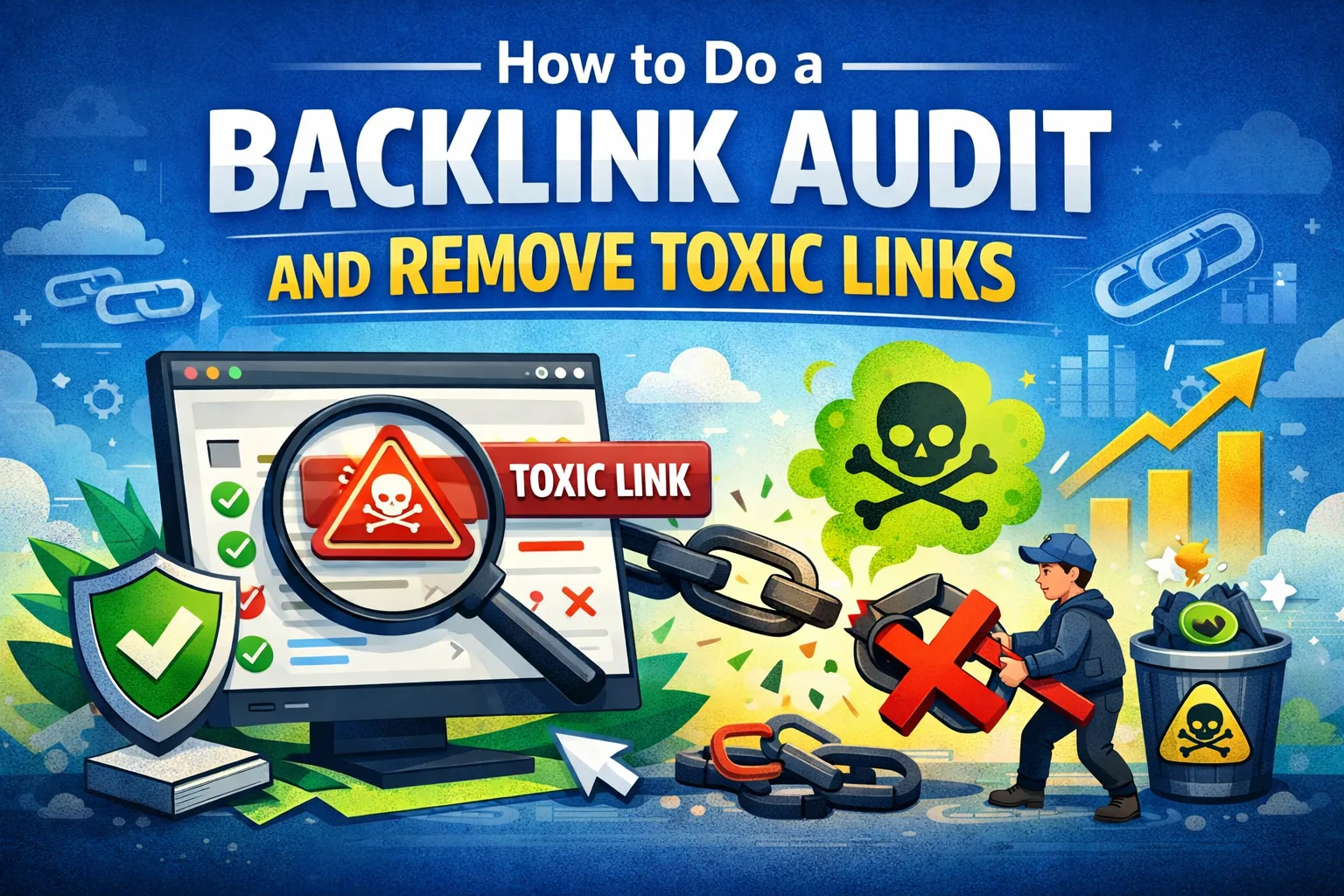
Backlinks are one of the most important ranking factors in SEO. The links enable search engines to assess your website’s trustworthiness and expertise. Not all backlinks provide advantages to websites. Backlinks from websites that have poor-quality content or that function as spammy sites will decrease your ranking.
This is where a backlink audit becomes essential. The tool allows you to examine your link profile, which helps you find dangerous links that will harm your performance. Backlink audits process that maintains website health while advancing search engine ranking results. The process plays an important role in enhancing your Off-Page SEO approach.
What is a Backlink Audit?
A backlink audit assesses all external links that connect to your website. The process aims to assess the links by their quality and relevance, and their link authority to determine their value.
The link audit SEO process needs this procedure because it helps you to find both beneficial and detrimental backlinks. A strong backlink profile supports better rankings, while poor-quality links can reduce your website’s credibility in search engines.
Why Backlink Audit is Important
Backlink audits serve a vital purpose to protect your website from receiving penalties and losing search engine rankings. Search engines use backlinks as trust indicators for websites, but spammy links will harm that trust relationship.
Regular audits enable you to identify toxic backlinks, which will lead to major problems. The removal or disavowal of these links enables you to sustain a strong link profile, which enhances your complete SEO results. It also assists in improving your backlink analysis, together with your link acquisition methods.
You may like to know : What is Domain Authority and How to Improve It
Signs of Toxic Backlinks
Some backlinks will do you more harm than good. In that case, do away with them or ignore them.
Here are common signs of toxic backlinks:
- Links from spammy or irrelevant websites
- Websites with very low authority or trust score
- Links from link farms or paid link networks
- Over-optimised anchor text
- Links from unrelated industries or foreign-language sites
- Sudden increase in backlinks within a short period
Knowing these patterns is crucial if you want to effectively remove toxic backlinks and keep a clean profile.
Tools You Need for Backlink Audit
The backlink audit process becomes more precise and effective when people use appropriate tools. Backlink analysis needs the following tools, which people use more frequently:
- Google Search Console – Shows backlinks directly from Google data
- Ahrefs – Provides detailed backlink insights and domain metrics
- SEMrush – Offers a backlink audit feature with toxicity scores
- Moz Link Explorer – Helps measure domain authority and link quality
- Ubersuggest – Beginner-friendly tool for backlink tracking
- Majestic SEO – Focuses on trust flow and citation flow
Using several tools, it is essential for one to have the bigger picture of the backlink profile for those noteworthy clean-ups or to ace one’s link audit SEO profile cleanup, truly, in due respect.
You may like to read : From SEO to GEO, AEO, AIO & LLMO: The New Era of Search Marketing
Step-by-Step Backlink Audit Process
Step 1: Collect All Backlinks
Start by gathering all your backlinks using tools like Google Search Console, Ahrefs, and SEMrush. The data should be exported to a spreadsheet, which will simplify the analysis process.
Step 2: Analyse Link Quality
You should analyze every backlink by assessing its domain authority, relevance, and trustworthiness. The task requires you to find links that display poor quality or suspicious characteristics.
Step 3: Identify Toxic Backlinks
You should use SEMrush and Ahrefs as tools to identify toxic backlinks on your website. The tools deliver scoring systems that enable you to identify dangerous links with ease.
Step 4: Categorise Links
You should separate all your backlinks into three groups: good links, suspicious links, and toxic links. The process identifies which links require immediate work.
Step 5: Remove Toxic Backlinks
Getting in touch with webmasters and asking them categorically to remove toxic backlinks is the most secure individual way to go.
Step 6: Use Google Disavow Tool
If you are unable to remove links on your own accord, use the Google Disavow Tool. This will signal search engines to exclude these links.
Step 7: Monitor Regularly
Website backlink audits need to occur at regular intervals. Sustained link profile oversight enables businesses to achieve successful Off-Page SEO results through their link profile management.
Related post : SEO vs. SMO : A Complete Guide to Boosting Online Visibility
Best Practices for Backlink Audit
Good results from the audit process are much more likely if best practices are adopted:
- Perform audits regularly (monthly or quarterly)
- Focus on high-quality backlinks rather than quantity
- Use multiple tools for better accuracy
- Maintain a record of removed and disavowed links
- Build strong, natural backlinks to improve your profile
These tactics may act as a twin boost for your backlink audit process and SEO performance.’
Common Mistakes to Avoid
When you avoid various common mistakes, then you can make your backlink audit extremely more effective.
- Ignoring low-quality backlinks
- Removing good backlinks accidentally
- Depending on only one tool
- Not updating backlink data regularly
- Overusing the disavow tool
You can use SEO tools to simplify the process of backlink analysis or a class of domains.
Conclusion
A backlink audit plays a vital role in sustaining an effective SEO strategy. The process identifies harmful links, which boosts website credibility and protects your site from penalties.
The implementation of a systematic backlink audit process, together with appropriate tools and continuous backlink monitoring, will help you achieve better search engine rankings and increased website authority. The process of eliminating harmful backlinks and building high-quality links will enhance your Off-Page SEO performance and result in sustainable SEO growth.
FAQs
What is a backlink audit?
The process of scrutinizing all kinds of links that point toward a website, dissecting them for quality or their SEO impact.
How often should I do a backlink audit?
It is an advisable practice to perform a backlink audit every 1-3 months based on the size of your site.
What are toxic backlinks?
Toxic backlinks are links that come from a spammy or low-quality website and have the potential to hurt the rankings of the targeted website.
How can I remove toxic backlinks?
Toxic backlinks can hurt your SEO, so they should be removed quickly. First, identify harmful links using tools like Google Search Console or Ahrefs. Then, contact the website owner and request removal of the link. If there’s no response, use Google’s Disavow Tool to ignore those links. Regular monitoring helps keep your backlink profile clean.
Which tools are best for backlink analysis?
The popular tool list is pretty common and includes Google Search Console, Ahrefs, SEMrush, Moz, Ubersuggest, and Majestic SEO.

Harsh Mistri is a Digital Marketing Executive with over 8 years of experience in SEO, online marketing, and growth strategies. He is passionate about exploring the evolving digital landscape and enjoys writing about technology, SEO, and digital marketing.