
Search engine optimization is changing. Today, search engines do more than match keywords. They try to understand the meaning, context, and intent behind every search query.
This is where Semantic SEO becomes important. It helps search engines understand your content, its topics, and the relationships between different concepts.
Whether you run a business website, SaaS platform, or blog, understanding Semantic SEO can help you create more useful content and improve your search visibility.
In this guide, we will explain Semantic SEO, share practical Semantic SEO examples, explore a complete Semantic SEO framework, and show you how to implement Semantic SEO for your website.
What Is Semantic SEO?
Semantic SEO is the process of creating and optimizing content around topics, meaning, search intent, and relationships between related concepts rather than focusing only on individual keywords.
It helps search engines understand what your content means and how different pages on your website are connected.
For example, if you write about digital marketing, related topics may include SEO, content marketing, keyword research, link building, and search intent.
Covering these related topics naturally helps create a more complete resource for readers.
How Does Semantic SEO Work?
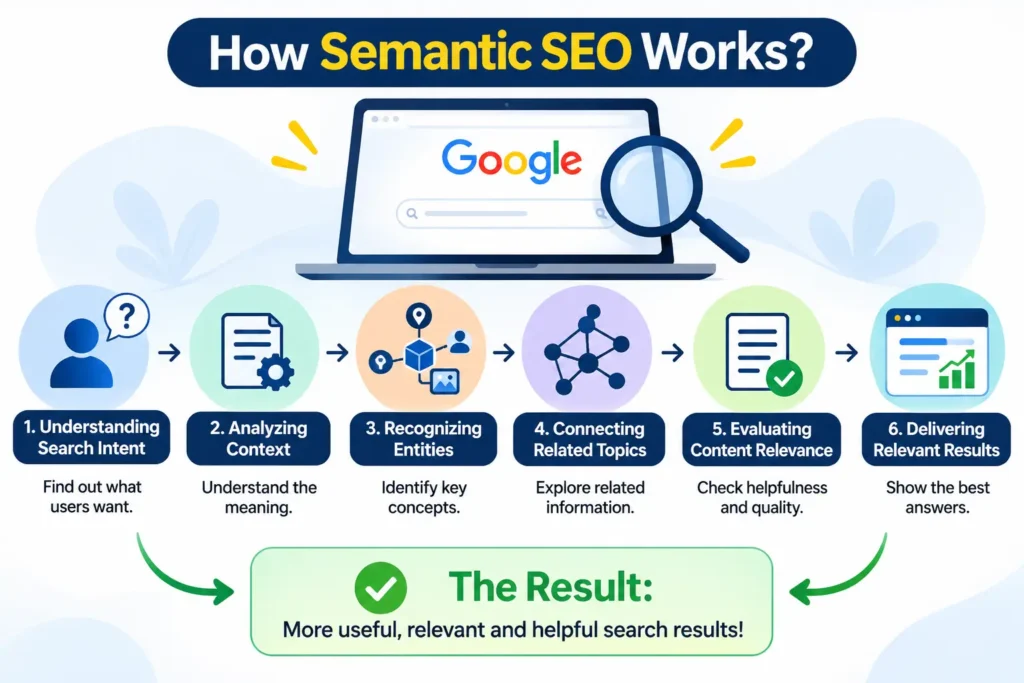
Semantic SEO works by helping search engines understand the meaning, context, and relationships between words and topics on a webpage. Instead of focusing only on exact-match keywords, it considers search intent, related concepts, entities, and content relevance.
For example, if someone searches for “best project management software,” search engines try to understand related needs such as task management, team collaboration, pricing, workflow automation, and productivity.
Here is how Semantic SEO works step by step:
- Understanding Search Intent: Search engines identify what users want to find, learn, or purchase.
- Analyzing Context: They consider the words and surrounding information to understand the meaning of a search query.
- Recognizing Entities: They identify people, businesses, products, places, and concepts related to the topic.
- Connecting Related Topics: Search engines understand relationships between subjects and supporting information.
- Evaluating Content Relevance: They assess how well a webpage answers the user’s search query.
- Delivering Relevant Results: They use these signals, along with many other ranking factors, to provide useful search results.
What Is Semantic Search?
Semantic search is the process through which search engines interpret the meaning and intent behind a user’s search query.
Instead of looking only at exact keywords, search engines use context, language understanding, and relationships between concepts to provide relevant results.
For example, someone searching for “best laptop for students” may also need information about battery life, performance, price, and portability.
Search engines try to understand these needs and deliver useful results.
Why Semantic SEO Matters
Semantic SEO matters because users search for information in different ways. A single keyword may represent several questions or search intentions.
Creating content around related topics helps you provide more complete answers and improve the overall user experience.
Here are some important benefits of Semantic SEO.
1. Better Understanding of Search Intent
Semantic SEO helps you understand what users actually want when they search online.
Instead of repeating one keyword, you can answer related questions and provide useful information that matches different search intentions.
2. Improved Topical Authority
Publishing useful content around a specific subject helps establish your website as a valuable resource.
For example, a website covering SEO can publish articles about technical SEO, keyword research, link building, and content optimization.
3. Better Content Relevance
Semantic SEO encourages you to include relevant concepts, entities, and supporting information.
This makes your content more informative and helps readers understand a topic without visiting multiple websites.
4. More Keyword Opportunities
A single topic can include several related search queries.
By covering these topics naturally, your website may become relevant for a wider range of long-tail and related searches.
5. Improved User Experience
Well-structured content makes it easier for visitors to find answers.
Clear headings, short paragraphs, useful examples, and internal links help readers navigate your website.
Semantic SEO vs Traditional SEO
Traditional SEO often focuses heavily on individual keywords, backlinks, and on-page optimization.
Semantic SEO takes a broader approach by focusing on topic relationships, search intent, entities, and content meaning.
Both approaches are useful, but modern SEO requires understanding what users are actually looking for.
Key Differences
Traditional SEO: Focuses more on individual keyword targeting, keyword placement, and page-level optimization.
Semantic SEO: Focuses more on topic coverage, search intent, related concepts, entities, and contextual relationships.
For example, traditional SEO may target the keyword “email marketing software” on one page.
Semantic SEO may also cover email automation, campaign management, subscriber segmentation, analytics, and email deliverability.
This creates a more comprehensive resource for users.
Semantic SEO Examples
Understanding Semantic SEO becomes easier when you look at practical examples.
Here are some examples of how you can apply it to your website.
Example 1: SEO Services
Suppose your main topic is SEO services.
Instead of writing only about SEO services, you can cover related topics such as:
- Technical SEO
- On-page SEO
- Off-page SEO
- Keyword research
- Link building
- Website audits
- Content optimization
These topics help explain the different aspects of SEO services.
Example 2: SaaS Software
Suppose you run a SaaS company that offers project management software.
Your content can cover project planning, team collaboration, task management, workflow automation, reporting, and productivity.
These related concepts help explain the purpose and benefits of your software.
Example 3: Digital Marketing
For a digital marketing website, you can create content about SEO, social media marketing, paid advertising, email marketing, content strategy, and conversion optimization.
Each article can link to other relevant pages to create a connected content structure.
What Is a Semantic SEO Framework?
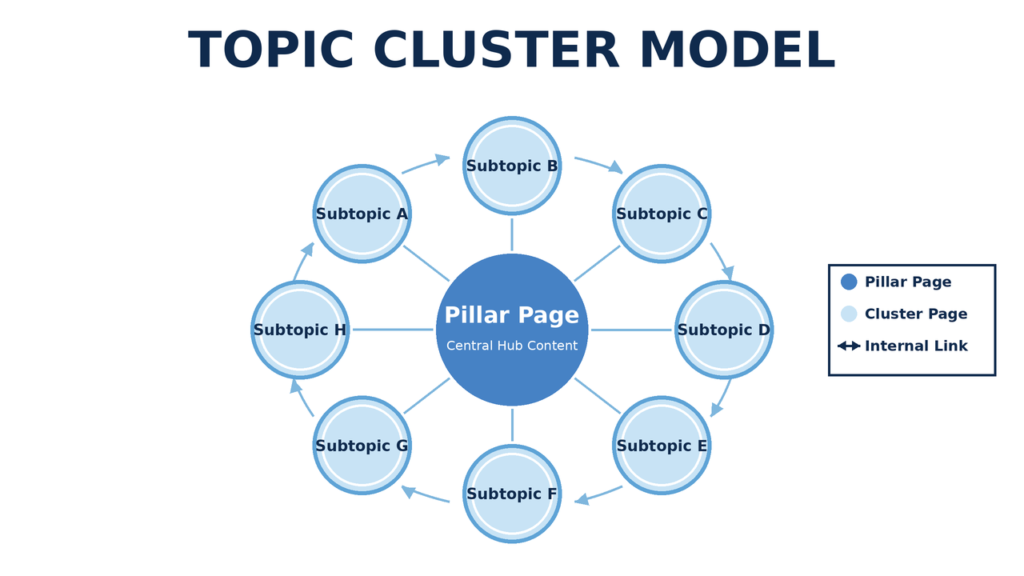
A Semantic SEO framework is a structured approach to planning, creating, and optimizing content around a central topic.
It helps you organize related keywords, understand user intent, build topic clusters, and connect relevant website pages.
A practical Semantic SEO framework includes the following steps.
1. Identify Your Main Topic
Start by selecting the main subject you want your website to rank for.
Choose a topic that matches your business, audience, and services.
For example, if you run an SEO agency, your main topic could be search engine optimization.
2. Perform Semantic Keyword Research
Find keywords and questions related to your main topic.
Look for synonyms, long-tail keywords, related searches, and questions people commonly ask.
You can use tools such as Google Keyword Planner, Semrush, Ahrefs, and Google Search Console.
3. Understand Search Intent
Identify why users are searching for a particular keyword.
Search intent generally includes four major categories:
- Informational: Users want to learn something.
- Navigational: Users want to find a specific website.
- Commercial: Users are researching products or services.
- Transactional: Users are ready to take action or make a purchase.
Create content that matches the purpose behind each search.
4. Build Topic Clusters
Organize related content around a central topic.
For example, a main SEO guide can connect to supporting articles about keyword research, technical SEO, link building, and content optimization.
This structure helps users discover related information.
5. Optimize Content Around Entities
Entities are identifiable people, places, organizations, products, and concepts.
For an article about SEO, related entities may include Google Search, Google Search Console, crawling, indexing, backlinks, and structured data.
Use relevant entities naturally when they help explain your subject.
6. Create Helpful and Complete Content
Write content that answers the main question and covers important supporting topics.
Use simple language, practical examples, descriptive headings, and clear explanations.
Avoid adding unrelated keywords just to increase keyword coverage.
7. Add Relevant Internal Links
Connect related articles using descriptive anchor text.
For example, an article about keyword research can link to your guide about content optimization.
Internal links help visitors navigate your website and help search engines discover related pages.
8. Monitor and Improve Content
Review your website’s search performance regularly.
Use Google Search Console to identify impressions, clicks, queries, and pages that need improvement.
Update outdated information and improve sections that do not fully answer user questions.
How to Implement Semantic SEO
Implementing Semantic SEO requires consistent research, planning, and content improvement.
Follow these practical steps to get started.
Step 1: Research Your Audience
Understand your target audience, their problems, and the questions they ask.
This helps you select topics that are relevant to your business and useful to potential customers.
Step 2: Analyze Search Results
Search your main keyword on Google and review the results.
Look at the topics competitors cover, the questions they answer, and the type of content ranking for your keyword.
Use this research to identify missing information and opportunities to create better content.
Step 3: Create a Content Plan
Prepare a list of main topics and supporting articles.
Group related keywords according to search intent instead of creating separate pages for every keyword variation.
This helps prevent unnecessary content duplication.
Step 4: Write Natural and Relevant Content
Create content that answers questions clearly.
Include related terms, examples, statistics, and supporting information wherever they add value.
Do not force keywords into sentences or repeat them unnecessarily.
Step 5: Use Structured Headings
Organize your content using descriptive H1, H2, and H3 headings.
A clear heading structure makes long articles easier to read and helps visitors find relevant information.
Step 6: Add Structured Data Where Appropriate
Structured data helps search engines understand specific information on a webpage.
For example, relevant Schema.org markup can describe products, organizations, articles, and other supported content types.
Use accurate structured data that matches the visible content on your page.
Step 7: Improve Technical SEO
Make sure your website is easy to crawl and navigate.
Pay attention to mobile usability, page loading performance, indexing, canonical URLs, and broken links.
Good technical SEO helps search engines access and understand your content.
Step 8: Measure Your Results
Track your website’s performance using Google Search Console and analytics tools.
Review organic clicks, impressions, keyword performance, and conversions.
Use these insights to improve your content strategy over time.
Best Tools for Semantic SEO
The right tools can make Semantic SEO research and content planning easier.
Here are some useful options:
1. Google Search Console: Helps you understand search queries, impressions, clicks, and website performance.
2. Google Keyword Planner: Helps discover keyword ideas and estimate search demand.
3. Semrush: Provides keyword research, competitor analysis, and content optimization features.
4. Ahrefs: Helps research keywords, backlinks, competitors, and content opportunities.
5. AlsoAsked: Helps discover related questions and understand how search questions connect.
6. Google Trends: Helps explore search interest and compare topic popularity over time.
Each tool supports a different part of the SEO process. You do not need every tool to build a successful Semantic SEO strategy.
Common Semantic SEO Mistakes to Avoid
While implementing Semantic SEO, avoid these common mistakes:
- Keyword stuffing: Repeating keywords unnaturally can make content difficult to read.
- Unrelated topics: Adding irrelevant information does not improve topical relevance.
- Duplicate content: Creating multiple pages targeting the same intent can confuse your content strategy.
- Ignoring search intent: Content should answer what users actually want to know.
- Poor internal linking: Disconnected pages make navigation and content discovery harder.
- Writing only for search engines: Always prioritize helpful information and a good reading experience.
Focus on creating useful, accurate, and well-organized content rather than trying to manipulate search rankings.
Frequently Asked Questions About Semantic SEO
1. What is Semantic SEO in simple words?
Semantic SEO means optimizing content around the meaning of a topic, related concepts, and user search intent instead of focusing only on exact-match keywords.
2. What are some Semantic SEO examples?
Examples include creating topic clusters, covering related questions, connecting supporting articles through internal links, and using relevant entities in your content.
3. What is a Semantic SEO framework?
A Semantic SEO framework is a process for researching topics, organizing related keywords, understanding search intent, creating content clusters, and optimizing website pages.
4. What is the difference between Semantic SEO and traditional SEO?
Traditional SEO often emphasizes individual keyword targeting, while Semantic SEO focuses on topic meaning, contextual relationships, entities, and search intent.
5. Does Semantic SEO improve Google rankings?
Semantic SEO can help improve content relevance and search visibility when implemented effectively. However, it does not guarantee rankings because Google considers many factors when selecting search results.
6. Are keywords still important in Semantic SEO?
Yes. Keywords remain important for understanding what users search for. Semantic SEO expands keyword research by considering related concepts, context, and search intent.
7. How long does Semantic SEO take to show results?
There is no fixed timeline. Results depend on competition, website authority, content quality, technical SEO, and how frequently search engines discover and evaluate updated content.
8. Is Semantic SEO important for small businesses?
Yes. Small businesses can use Semantic SEO to create useful topic-focused content, answer customer questions, and improve their visibility for relevant searches.
Conclusion
Semantic SEO is an important part of building a modern content strategy. It helps businesses create meaningful content that covers topics, answers user questions, and connects related information.
By following a clear Semantic SEO framework, researching search intent, building topic clusters, and improving internal links, you can create a more organized and useful website.
Start with your main topics, understand your audience, and publish high-quality content consistently. Focus on providing real value to readers rather than simply targeting more keywords.
A well-planned Semantic SEO strategy can support long-term organic growth and help your website become a valuable resource in its industry.
Ready to grow your online presence with smarter SEO strategies? Visit MashupMind for expert digital marketing insights, practical SEO tips, and actionable strategies to improve your website’s visibility, attract the right audience, and grow your business digitally!

I’m Kishan Rana, an SEO professional and digital marketing specialist with over 8 years of hands-on experience in search engine optimization, organic growth strategies, and online visibility enhancement. I’m passionate about analyzing search algorithms, exploring ranking strategies, and helping businesses build sustainable traffic through data-driven SEO practices. Through Mashupmind, I share practical insights, industry trends, and actionable techniques designed to help brands grow smarter in the digital landscape.