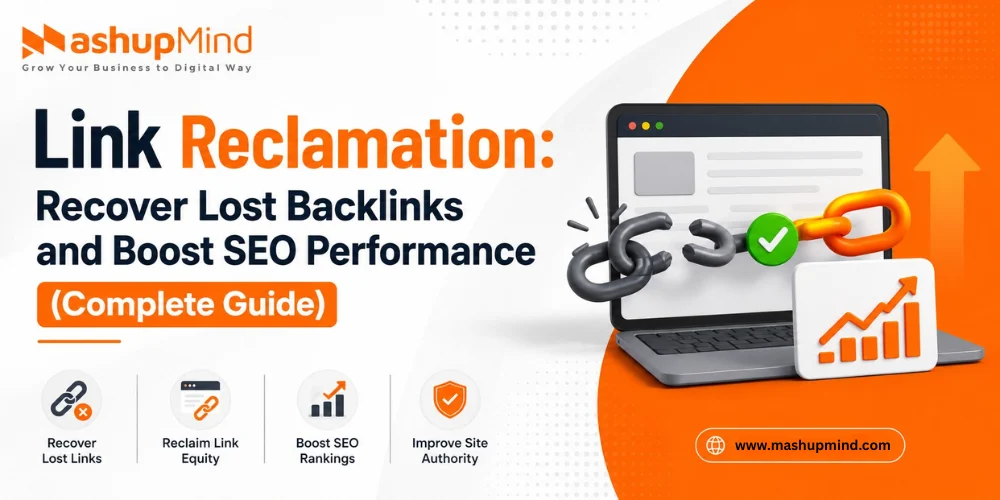
When we talk about SEO, everyone thinks of getting new backlinks via outreach, guest posting, or a Link Building Service. However, there is one thing that most companies neglect and is lying directly in front of them—reclaimed backlinks.
A website will lose backlinks over time for reasons such as changes in content, website migration, deletion of webpages, or even some changes in third-party sites that are linking to the website. That loss in value silently affects ranking, traffic, and domain authority.
Here is where link reclamation becomes a high ROI strategy in SEO and off-page SEO. As opposed to building links all over again, link reclamation means recovering your previously earned links.
This link reclamation guide covers everything you need to know, including what link reclamation is, its importance, finding lost links, fixing them, and scaling the process.
What Is Link Reclamation?
Link Reclamation involves identifying and retrieving any backlinks that you may have lost due to the links being deleted or because they no longer lead to your site.
Lost links can be classified into three broad types:
- Backlinks that previously existed but got deleted
- Backlinks that lead to a broken or obsolete URL
- Brand mentions without an associated link
Why reclaimed links are easier wins than new link building
Unlike Broken Link Building, digital PR, or even guest blogging, link reclamation does not involve persuading a site owner to link to you for the first time.
On the contrary:
- You had a connection with the site owner beforehand
- The page in question linked to your website before
- It used to be valuable for your site
As such, you can easily convert, achieving quicker and more efficient results.
Link Reclamation vs Traditional Link Building
The traditional approach to link building emphasizes gaining fresh links by doing outreach and other related activities.
Link reclamation is all about:
- Gaining back authority
- Addressing any problems associated with your site’s technical SEO
- Leveraging your existing equity
Often, the most efficient way to boost rankings in an SEO campaign is through link reclamation rather than producing more content.
Why Link Reclamation Matters for SEO
Link reclamation allows you to retrieve lost link equity from those links that used to pass along authority to your web page. Whenever these links get lost because of page deletion, a change in URLs, or even any change in content, their SEO value gets lost as well. This way, link reclamation would allow you to regain this authority, which will certainly help in better rankings of your web page.
It will also allow you to recover referral traffic, as many of these backlinks come from real people visiting your website but cannot access it anymore whenever there is a broken link or loss of any link. Another factor is that maintaining a good profile of backlinks will help improve your domain authority and trust signals. As compared to other techniques, such as HARO Link Building, guest posting, and outreach, link reclamation has more benefits and a quicker return on investment.
You may like to know: Programmatic SEO, Explained for Beginners
Types of Link Reclamation Opportunities
Variations consist of lost backlinks, broken links, unlinked mentions, images and redirect recovery opportunities.
1. Lost Backlinks
These are links from external sites to yours that previously existed but have since been removed. Although they once contributed value to your site’s SEO, these are naturally removed by the linking site or by you on your own site.
Causes include:
- Publisher removing the link as the content is edited or rewritten.
- Pages are deleted or archived.
- Edits are made to editorial pages that may result in a removal of the external resource.
- New resources that have not retained outbound links, while replacing old resources.
It directly harms your SEO since any link juice and referral traffic the link used to drive is now completely gone.
2. Broken Backlinks
These are links pointing to non-existent pages on your site from pages on outside domains. They still appear on other sites, but when someone clicks on one, it results in a 404 error-the link exists, but the page doesn’t.
Causes include:
- Site migrations when URLs are changing.
- A change in URL structure, without appropriate redirection maps.
- Disappearing landing pages, or removed products or services.
- Technical issues with redesigns or CMS updates.
Broken backlinks can do a lot of damage; they indicate that a website is poorly managed and can also lose potentially useful link equity that could help a site’s rankings.
3. Unlinked Brand Mentions
A brand name or product and website mention that is not linked back to your website. In this situation, you still get awareness, but you miss out on the SEO value associated with a clickable back link.
One of the easiest and most profitable link reclamation opportunities, as the author already has an awareness of your brand, and turning a mention into a backlink is typically very straightforward, requiring minimal effort and simple outreach.
4. Image Link Reclamation
This is when another website is using your image, graphic, or visual asset without proper accreditation, in the form of an actual backlink to your website. The other website is benefiting from using your content, but the SEO power is not directed back to you.
The process of reclaiming these links helps regain authority, increase the profile of your brand, and obtain correct attribution and protect your original asset. This is also a fantastic opportunity to turn misuse of your original asset into an SEO opportunity.
5. Redirect Reclamation
Redirect recovery specifically relates to retrieving wasted link equity from unredirected URL changes. Essentially, when a URL is moved without a proper redirect, incoming links lose all value they previously held to the old URL.
Common situations include:
- Changes to the website through rebranding
- Website migration that changes the URL structure
- Redesign of the website, involving the replacement of old pages by new ones
In case there are no appropriate 301 redirects in place, all the link equity gets wasted. Proper redirection helps to ensure that the link authority gets transferred to the new pages.
How to Find Lost Backlinks
For accurate link reclamation, you need a stable source.
Using Ahrefs
Backlink analysis is typically done with Ahrefs.
Key features:
- Lost backlinks report
- Referring domain tracking
- Historical backlink comparison
- Anchor text analysis
Using Google Search Console
Google Search Console helps identify:
- Pages receiving links
- Indexing issues
- URL-level performance tracking
Using Semrush
Semrush provides:
- Lost and gained backlink tracking
- Backlink audit reports
- Competitor link gap analysis
Using Majestic
Majestic focuses on:
- Trust Flow metrics
- Citation Flow metrics
- Historical link intelligence
Key data to analyze:
- Lost referring domains
- Link velocity trends
- Pages with highest backlink loss
How to Analyze Lost Links
However, not all lost backlinks require restoration; hence, it is very important to conduct an evaluation first before engaging in any restoration activity. Firstly, domain authority must be considered, as sites with higher domain authority are the ones to prioritize because they have higher SEO value.
It is also very important to consider the relevance of the links to be restored. Backlinks coming from sites in the same industry or niche will be better SEO-wise than backlinks coming from irrelevant sites. Traffic volume of the source site is also very important in order to regain the lost traffic.
The quality of anchor texts must be evaluated because keyword-relevant anchors will bring additional SEO benefits and provide more information for search engines. Lastly, follow and nofollow links make a difference because the former brings more authority and affects ranking.
Prioritization Framework
| Priority | Criteria |
|---|---|
| High | Relevant + high authority + traffic |
| Medium | Relevant but low authority |
| Low | Irrelevant or spammy domains |
Concentrate only on valuable link-building, and this way off-page SEO will achieve a greater ROI.
You may like to read: SEO Content Audit: The Complete Framework to Improve Rankings, Traffic & Conversions
Broken Link Reclamation
Lost links are one of the quickest SEO gains you can achieve.
Common causes:
- Deleted pages
- CMS migration errors
- URL structure changes
- Improper redirects
How to fix broken links:
The issue of broken links can be solved by using 301 redirects to redirect the old URLs to an existing live URL, thereby maintaining the link equity of the website. When the old URL contained useful information, then regenerating that page will be the best way forward.
Any old or inaccurate URL needs to be changed wherever necessary in order to make sure that everything is correct and consistent. When the original pages that had been lost were quite crucial, then they needed to be brought back to recover any lost SEO potential. The Screaming Frog tool works great for finding broken pages.
Unlinked Brand Mention Reclamation
Linking to brand mentions without direct links via outreach allows the boost of SEO authority and visibility
How to Find Mentions
Monitor mentions using Google Alerts, SEO tools, and content discovery tools. Ahrefs Content Explorer allows you to find mentions on the web, while Google Alerts sends notifications every time a brand is mentioned online.
Outreach Process
Firstly, find the pages that mention your brand. Identify the contact of the author of that page or find the author of that page. Then ask them politely to insert your link, and again inform them after a few days. Generally, conversion rates are very high as your brand is already mentioned on those pages.
Link Reclamation Outreach Strategy
The success of link reclamation largely depends on outreach.
Lost Link Email
Lost link emails are designed to serve as a reminder to the webmaster of a former backlink to your site. You simply list the old link, the new URL, and gently ask that the link be updated as soon as possible.
Broken Link Email
Broken link emails identify that a link on their website directs to a 404 page/dead link. You highlight this problem and mention your relevant page.
Brand Mention Email
Brand mention emails-we send these when your brand is mentioned, but no link is included. You simply thank the source and gently ask if they would include a backlink.
Best Practices
Ensure emails are brief and concise, write personal emails for increased interaction, skip all spammy words, and follow up with one to two emails if necessary.
Tools
The BuzzStream tool and similar ones automate the process of outreach. It also helps in contact management and monitoring the follow-up process.
Redirect Reclamation
Your redirects should carry SEO value.
Common scenarios:
- Website migrations
- HTTPS changes
- URL restructuring
- Product page updates
Problems caused by poor redirects:
- Lost backlink authority
- Broken referral traffic
- Ranking drops
- Crawl inefficiencies
When 301 redirects are set up properly, they will pass link equity properly to the new page.
Related posts: The Future of Search: SEO, GEO, AEO, AIO & LLMO Explained
Common Link Reclamation Mistakes
Reasons for failure of an SEO team are plenty:
- Targeting irrelevant links to build.
- Neglecting to address the redirect problem
- Not reviewing loss of links often enough
- Generic outreach to link sources
- Trying to recuperate spammed links
- Forgetting to correct internal links.
Do not make these mistakes, and the performance of SEO Mistakes TO Avoid will go up exponentially.
Best Link Reclamation Tools
Here is the list of Backlink Audit or Link Reclamation Tools which you can use.
| Tool | Best For |
|---|---|
| Ahrefs | Lost backlink tracking |
| Google Search Console | Index & link discovery |
| Semrush | Backlink audits |
| Screaming Frog | Broken link detection |
| BuzzStream | Outreach management |
Link Reclamation Workflow (Step-by-Step)
Workflow with structure enables scalability:
- Export backlink profile
- Identify lost backlinks
- Segment opportunities
- Prioritize high-value links
- Fix technical issues (redirects, 404s)
- Conduct outreach campaigns
- Track recovered links
- Measure SEO impact
This procedure could be repeated each month in order to further improve its SEO attributes.
Link Reclamation vs New Link Building
| Factor | Link Reclamation | New Link Building |
|---|---|---|
| Speed | Fast | Slow |
| Cost | Low | High |
| Effort | Medium | High |
| Success Rate | High | Moderate |
| Dependency | Existing Links | New Outreach |
Both Broken Link Building and Guest Posting remain very relevant and have their roles to play, but quick SEO wins tend to occur in reclamation.
Real Link Reclamation Case Study (Example)
There were the following alterations for a SaaS company after link reclamation:
- 150 lost backlinks post-redesign
- 92 links recovered
- 28% increase in organic traffic over 45 days
- Major improvements in rankings for key pages
- 18% uplift in demo sign-ups from organic search
It is evident that the strength of link reclamation cannot be underestimated.
Final Thoughts
Link Reclamation is still considered to be one of the most underrated and effective SEO tactics available. Instead of spending a lot on Link Building Services, it is much better to focus on recovering from any loss of authority, fixing all technical SEO problems, and getting higher rankings.
Link Reclamation becomes an integral part of organic growth in addition to HARO for Link Building, Broken Link Building, and off-page SEO efforts.
Whereas link building deals with growth, link reclamation deals with recovery, and recovery is much more profitable than growth in SEO.
FAQ
What is link reclamation?
A technique that helps retrieve lost or orphaned backlinks to increase your SEO value.
How do you find lost backlinks?
Data Assembly with Ahrefs, Google Search Console, and Semrush
Is link reclamation worth it?
Yes, because it delivers some of the quickest ROI for SEO and off-page SEO.
How often should you check for lost links?
Once per month at least.
Can reclaiming backlinks improve rankings?
Indeed, regaining lost authority results in a fast improvement in ranking position.
What is the difference between link reclamation and link building?
Link building can be a consequence of reclamation or the creation of new backlinks.

I’m Kishan Rana, an SEO professional and digital marketing specialist with over 8 years of hands-on experience in search engine optimization, organic growth strategies, and online visibility enhancement. I’m passionate about analyzing search algorithms, exploring ranking strategies, and helping businesses build sustainable traffic through data-driven SEO practices. Through Mashupmind, I share practical insights, industry trends, and actionable techniques designed to help brands grow smarter in the digital landscape.