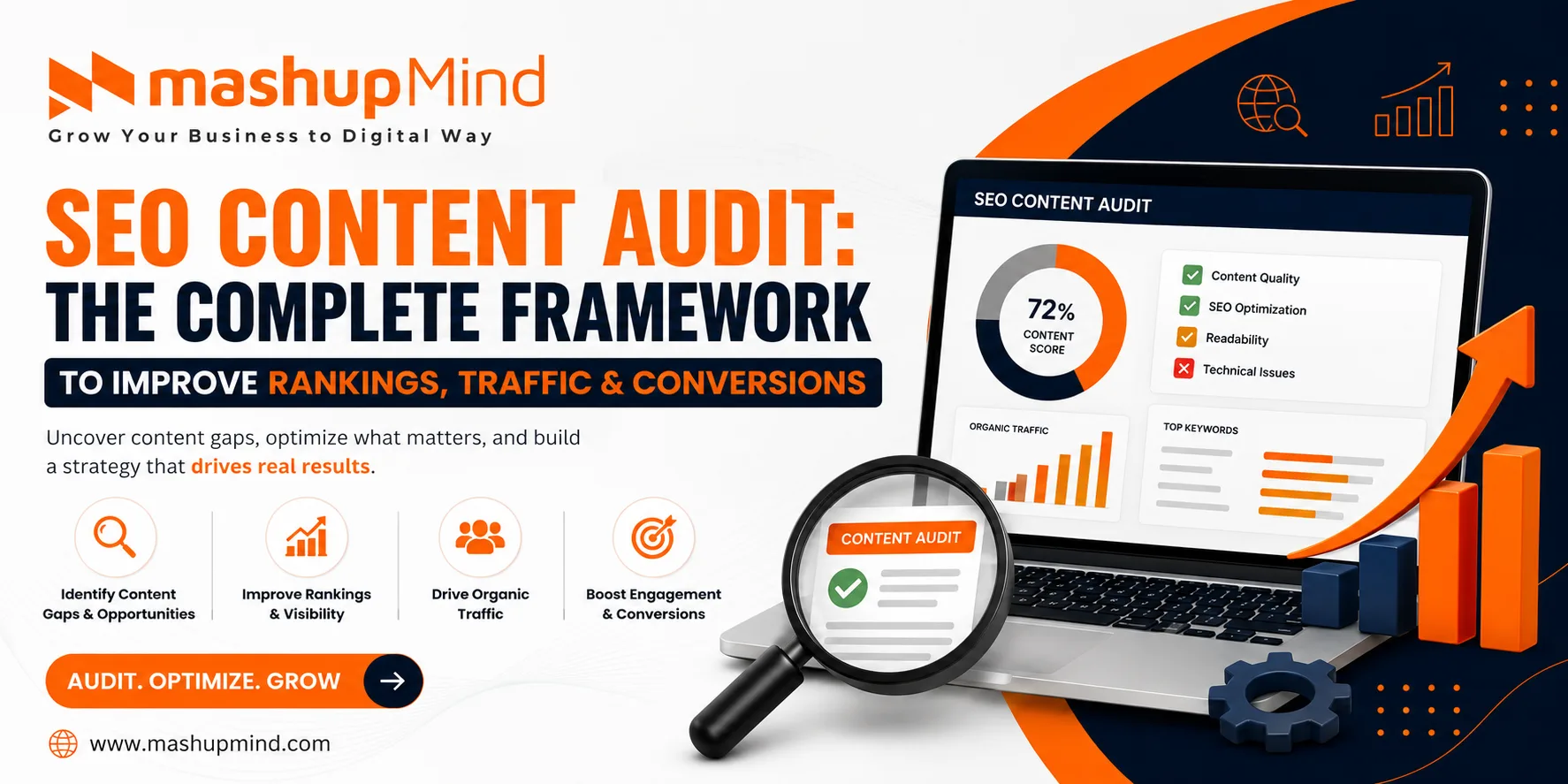
An SEO content audit is a process that websites undergo to improve their rankings, traffic, and conversions. The process of conducting an SEO content audit can be achieved by using an SEO content audit tool and by following an SEO content audit checklist.
The process of completing an SEO content audit uncovers content gaps, out-of-date pages that need to be updated, and many areas where web page content can be optimized in order to increase visibility in search engines. Many people wonder what an SEO content audit is, how an SEO content audit is completed as part of a wider SEO service or content strategy, and why an SEO content audit is so important.
What Is an SEO Content Audit?
An SEO content audit is a detailed analysis of all content that is placed on a website in order to see how it is performing in the search engines and to look for places where the content can be improved in order to achieve better results.
Content Audit vs SEO Audit
Both audits are important, but a content audit is specifically used to evaluate the quality of your content and identify areas for improvement. A successful content audit also helps to recognize strong-performing content, which can then be used as a model for future content.
On the other hand, an SEO audit focuses on all of the various factors of technical SEO. For example, the speed of your website, how well individual pages are indexed, and how easily your website can be crawled by search engines in order to be indexed in the first place.
Why Audits Matter
Content decay is currently the biggest threat to rankings and traffic. As websites grow, the best-intentioned teams can forget about their content. As time passes, the content slowly drops in ranking until it is eventually dropped from the index completely. The SEO content audit will highlight the strongest-performing pages on your website and allow you to update your worst-performing pages to reflect the current search intent.
Benefits of an SEO Content Audit
Improve Rankings
An SEO content audit will highlight your website’s outdated, thin, and poor-quality content that is holding your website back from achieving higher rankings and quality traffic. Upgrading your sub-performing pages with fresh, high-quality content that is optimized for relevant keywords can instantly boost your website’s search engine rankings and start bringing in more targeted traffic.
Increase Traffic
Find the traffic-generating content for your poorly performing pages and watch them shoot up in the search engine results pages to increase your organic traffic without creating new content.
Find Content Gaps
A content audit identifies the content gaps on your website. These include the topics, keywords, and user questions that you are not currently addressing. Use this information to create relevant content for your target audience and increase your online presence to attract new business to your website.
Improve Conversions
During an SEO content audit, you will often discover where traffic is going on your website that doesn’t convert into leads or sales. By optimizing the content in these areas, increasing the quality of the content, and including outbound calls-to-action, you will start to see an increase in conversion rates.
Build Topical Authority
Creating content on related topics and then optimizing that content for search engines can help establish your site’s authority on those topics over time, allowing you to rank for a variety of different keywords.
When Should You Conduct a Content Audit?
After a Google Update
A Content Audit after a Google Update (e.g., after a Panda or Penguin update) can help you see if your pages have gained or lost rankings.
Traffic Decline
If organic traffic to your website suddenly drops, a content audit can help identify the reasons for the drop as well as other outdated pages and general SEO problems on your website.
Website Migration
Do a content audit before you start the website migration and after the website migration to protect your page ranking and to make sure your users can still find the content you wrote.
Quarterly Review
A quarterly review of your current content will ensure that it is up to date and relevant for current search trends.
Annual Audit
This type of audit can go through all of the content you have created over the years. It can help you to determine whether your older content is still working to meet your long-term SEO goals.
You may like to know : Programmatic SEO, Explained for Beginners
Create a Complete Content Inventory
Make a complete content inventory for your website as a basis for your audit. In a list, enter all content on your website.
| Content Type | Examples |
| Blog Posts | Educational and informational articles |
| Landing Pages | Service and lead generation pages |
| Category Pages | Product or topic categories |
| Product Pages | Individual product listings |
| Resources | Guides, ebooks, case studies |
Metrics to Collect During an SEO Content Audit
These values will help to decide for every single piece of content whether it is better to update, to merge with another piece of content, to delete it completely, or to optimize it even further.
Traffic Metrics
Traffic metrics help determine the visibility of your web pages in search engines and how many users can potentially visit them.
Organic Traffic: This metric reveals how visible your content is in search engines, i.e., how many users visit your web pages after having entered a specific search query.
Impressions: The number of times your pages are displayed in search results.
Clicks: The number of clicks on links on pages, i.e., how often users click on content from search results on your site.
Engagement Metrics
A successful SEO content audit is not only about a huge number of pages and a huge amount of data, but it also helps you to understand how users interact with your content.
Time on Page: The amount of time users spend on a page.
Bounce Rate: The percentage of visitors that immediately leave a page after tracking them to a page on your site.
Scroll Depth: Measuring scroll depth on your web pages gives you a sense of just how much of your content users are actually reading.
SEO Metrics
These are the search performance metrics for measuring the search engine optimization of your content.
Keyword Rankings: Show where your pages rank for specified keywords.
Backlinks: Number of other websites linking to your pages.
Referring Domains: A count of how many websites are linking to a piece of content.
Internal Links: A measure of how well pages on your website are connected together.
Business Metrics
More important than traffic metrics for your online business are the business metrics, i.e., the value your content is creating for your business.
Leads: Inquiries, sign-ups, etc., like contact form submissions.
Conversions: The number of times a user completes a specific action on your website, for example by purchasing something, downloading a file, etc.
Revenue: The revenue that your content is generating for the business.
By using your chosen SEO content audit tool to track all of these, and more, metrics, you can work out which areas need a bit of a refresh to give you the best results. Paired with a solid piece of keyword research and the best of the current SEO automation tools out there, these metrics will increase your rankings, traffic, and conversions.
How to Analyze Content Performance?
Looking at how well your content is doing is a big part of checking your website’s content for search engine optimization. This helps you figure out which pages are helping you show up in search results, bringing in visitors, and getting people to do what you want them to do, and which pages need some work.
High-performing pages
When you’re looking at your website, there are some pages that really stand out – they get a lot of visitors, rank high in search results, and people actually interact with them and take action.
Declining pages
Declining pages are pages that previously performed well but have lost traffic or rankings over time. They often need content updates, improved optimization, or refreshed information.
Underperforming pages
These pages receive some traffic but are not reaching their full potential. Reviewing content quality, Keyword Research, and on-page SEO can help improve their performance.
Zero-traffic pages
Pages with little or no organic traffic should be carefully evaluated. They may need updating, merging, redirecting, or removal depending on their value.
Search Intent Audit
Informational intent
Informational intent focuses on users who want answers, explanations, tutorials, or educational content. Blog posts, guides, and how-to articles are commonly used to satisfy this type of search intent.
Commercial intent
Commercial intent applies when users are comparing products, services, or solutions before making a decision. Reviews, comparison pages, and case studies often perform well for these searches.
Transactional intent
When people show transactional intent, it means they’re ready to do something. They might want to buy something, get a quote, sign up for a service, or reach out to someone who can help them with SEO. This is a big step, and it’s important to be ready to help them take action.
Navigational intent
Search for a website, such as a brand, a specific website’s page or even the company’s website in general. Typically users searching for a website know exactly what they are looking for and use search engines to quickly find what they require.
Content Quality Evaluation Framework
Review every page using the following quality factors:
Accuracy
All facts, data and statistics, hyperlinks, images and examples on the page should be up to date, accurate and relevant. If the information on the page is out of date it will lead to user disengagement and a fall in search engine rankings. However the information can be updated on a regular basis using more accurate information sources.
Freshness
Make sure the content on your pages are up-to-date. This does not only mean that you will be able to provide your users with the latest information on trends and news in your industry, but also that the search engine will be able to determine that the pages on your site are meeting the needs of the users. Therefore, make sure to check for outdated statistics and replace them with the latest information.
Depth
In addition, every page should have sufficient information to allow the user to get all the information he or she needs from that page. This means that a page with thin content is difficult to get to rank, but in the end it provides a lot of value and user satisfaction.
EEAT
Experience, Expertise, Authoritativeness, Trustworthiness – the new way to look at building high-quality online content, by ensuring that your content provides the best possible user experience, written by people with the relevant knowledge and experience, who are recognized as authorities on the subject and are trusted by their users.
Readability
Readability of your online content is crucial to help your online visitors very quickly and easily find the information on your Internet pages that they are looking for. Short formatted paragraphs with clear headings and simple online written content all contribute to ensuring that your online visitors are not held up by having to read laboriously written online content. The logical online formatting of your online content is also critical.
Originality
Create unique value online and avoid duplication of already existing information online. Your content should provide original insights, examples, opinions etc. Even more in-depth research than your competition can trigger engagement with your online content.
Content Decay Analysis
Content decay is the gradual loss of rankings, traffic, and engagement as content becomes outdated.
Signs of decay
- Declining organic traffic
- Lower keyword rankings
- Reduced clicks and impressions
- Outdated information
Recovery methods
- Update content regularly
- Refresh target keywords
- Improve internal linking
- Add new information and examples
Lots of companies use special tools to find out if their online content is getting old and outdated. These tools, like SEO content audit tools and SEO Automation Tools, help them spot problems early on.
Content Pruning Strategy
| Action | Purpose |
| Keep | High performers |
| Update | Outdated pages |
| Merge | Similar pages |
| Redirect | Consolidation |
| Delete | Low-value pages |
Getting rid of useless content makes your website better and helps you keep only the pages that are really useful.
You may like to read : SEO vs. SMO : A Complete Guide to Boosting Online Visibility
SEO Content Audit Checklist (Step-by-Step)
Inventory URLs
Make a complete list of all URLs on your website, i.e. blog posts, landing pages, category pages, product pages, etc. Every page on your website should be included in your SEO content audit.
Gather metrics
These numbers can be used to evaluate the pages that are performing well and those that need to be optimized during the audit. As well as organic traffic numbers such as impressions, clicks and rankings, it is also very important to collect engagement and conversion numbers such as leads and sale
Evaluate content
This page should contain an assessment of the content found on each page of your website to help you establish whether your website contains quality relevant and accurate content, that is also up to date and is of value to the users of your website, and also your SEO goals.
Analyze keywords
To get the most out of your website, you need to see if you’re using the right keywords. This is called “keyword research”. Check if your pages are ranking for the relevant keywords and find other search terms that can bring more traffic to your website.
Review backlinks
Go through each page’s backlinks and check the number as well as quality of them. High quality backlinks can increase a website’s authority which can in turn result in higher rankings for single pages. On the other hand a weak backlink profile of a page can uncover chances for link building.
Check internal links
Review internal linking opportunities and issues across the website. Ensure important pages receive sufficient internal links and identify orphan pages that may be difficult for users and search engines to find.
Decide actions
Determine whether pages should be kept, updated, merged, redirected, or deleted. The decision should be based on performance data, content quality, and overall business value.
Prioritize updates
Focus first on pages that offer the highest potential impact on rankings, traffic, and conversions. Prioritizing updates helps maximize results while making the audit process more efficient.
Best SEO Content Audit Tools
To make your SEO content audit as efficient and precise as possible, you should use the right SEO content audit tools.
Google Search Console
Google Search Console is another tool to do an SEO content audit with as well. It shows your impressions, clicks, your rankings, and where your site is having problems with being indexed.
Google Analytics
Additionally, by utilizing Google Analytics 4 during your audit, you can gain great insights into the behavior of users on your website and levels of engagement, and also measure conversions and see where your traffic is coming from, allowing you to refine your SEO in the most productive areas.
Ahrefs
For a backlink analysis, to get keyword rankings, for content gaps, for a competitor analysis, etc. So you can highlight pages that need some improvement.
Semrush
Semrush offers a huge amount of auditing functions and also lots of Keyword Research, as well as the tracking of the rank of your website, the backlinks of your competitors or other websites, and much more within a huge database.
Screaming Frog
This web crawler crawls your website to highlight technical SEO problems on your site. Like a robot, it checks for things like broken links, duplicate content on pages, pages with no metadata, and ‘orphan’ pages with no links to them.
|
Your Content Could Be Costing You Rankings Get a Free SEO Consultation from MashupMind and uncover hidden growth opportunities today. [Get Your Free SEO Consultation] |
Final thoughts
A well-executed SEO content audit not only increases rankings, boosts organic traffic, and reveals content gaps, but also leads to more conversions. With the help of a well-structured SEO content audit checklist and the right SEO content audit tool, the results of your audit can be combined with your keyword research as well as with the insights of your SEO automation tools.
In this way, your content remains up-to-date, competitive, and user-intent aligned. Regular audits of your website support your long-term SEO growth and your business success.
FAQs
What is an SEO content audit?
An SEO content audit is a process to check your existing content on your website for performance as well as for possible improvements in order to increase your rankings, traffic, and also your conversions.
How often should I audit content?
SEO audits of your website’s content should be performed on a quarterly basis to check the performance of your content and also have a more detailed annual audit.
Which tools are best?
Google Search Console, Google Analytics 4, Ahrefs, Semrush and Screaming Frog are typical tools which are used for a content audit.
What is content pruning?
Content pruning: Keeping, updating, merging, redirecting or deleting content based on the content’s value and performance.
How long does a content audit take?
The time to complete an audit depends on the size of your website. For small websites with only a small amount of content, the audit can be completed within a few days. Larger websites with thousands of pages will need several weeks to complete a proper audit of all the content on the website.

Mahima is a Content Strategist and Freelance Writer specializing in creating engaging, SEO-driven content across multiple niches. She writes on business, technology, marketing, lifestyle, health, and education, helping brands connect with their audiences through clear and impactful storytelling. Her focus is on delivering well-researched, value-driven content that enhances visibility, engagement, and brand authority.