I still remember the first time we realized that our growth funnel was lying to us.
Traffic was climbing. Campaigns looked “successful.” Dashboards were green. But revenue refused to move, and sales conversations felt colder than they should have.
At first, we blamed execution. Then the content and then the ads. But alas, nothing changed. As a result, we eventually admitted that something deeper had gone wrong; maybe the funnel itself was outdated.
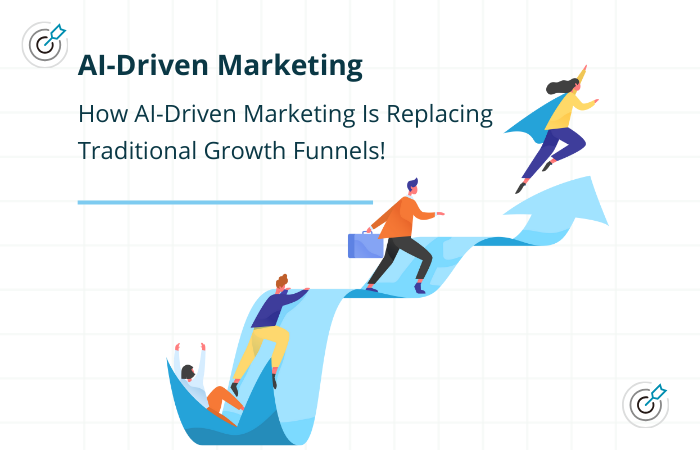
In 2026, buyers don’t move in straight lines anymore. They jump platforms, ask AI for answers, compare options instantly, and decide when they feel ready, not when a funnel stage says they should.
This is exactly why AI-driven marketing has certainly become the conversation. It doesn’t force people forward. It adapts, observes, and responds more like a human rather than a machine.
When Funnels Stopped Reflecting Reality?
Historically, marketing funnels were designed to provide a flow for customers’ journeys to businesses. However, when you fast-forward to 2026, when market conditions are more dynamic, companies need to be more proactive rather than reactive.
Therefore, following a pre-designed customer funnel and staying true to it does not serve business interests. It fails to present the right data at the right time that can be used to improve customer experience and influence purchase decisions.
- Funnels Assume Order. Buyers Don’t
The major problem with traditional funnels is that they assume engagement and intent are built in every step and culminate with a buying decision. However, when you see the real campaign data and user journey, the picture changes completely.
Real-time monitoring reveals that:
- Some prospects read a deep article and book a call immediately.
- Others consume multiple touchpoints and still hesitate.
- Some convert after seeing a single AI-generated answer without ever ‘entering’ the funnel.
This is how the traditional funnels fail to reflect reality. It treats everyone the same. But AI doesn’t make these mistakes; it knows.
This gap is where growth quietly leaks.
- Data is Not the Hurdle, Speed is
In the traditional marketing funnel, data is never the roadblock; it’s the speed. For instance, in one B2B campaign, it was noted that users who reached a specific comparison section on the landing page converted 3X as often, but engagement had to happen quickly.
Now that humans are reviewing the data, this is no longer possible, and a potential conversion opportunity is lost. On the contrary, when you employ an AI-driven approach, the engagement is taken care of at the right moment, leading to more conversions and business growth.
What AI-Driven Marketing Funnels Feel Like in Practice
AI has transformed the way modern marketing operates, and a prime example is the reimagination of the marketing funnel. So, the question now is: how does it feel to implement an AI-driven marketing funnel in practice? Here is how –
Less Control, More Awareness
When AI is implemented correctly, marketing stops feeling obvious and becomes more subtle. The benefits? Well, there are plenty. To start with –
You stop asking, “Which stage are they in?”
You start asking, “What are they responding to right now?”
This shift alone changes outcomes. You are no longer just looking at converting a user to a paid customer; instead, you are focusing on building a deeper relationship that will serve in the years to come.
As a result, you start curating the messages accordingly and focus more on delivering knowledge and building awareness rather than stuffing the users with an abundance of promotional material. It lowers the experience and hurts conversion prospects.
Timing Is the Real Advantage
Most people think AI is about automation. However, AI-driven marketing is all about timing.
AI understands:
- When curiosity becomes intent
- When hesitation signals confusion, not disinterest
- When silence means ‘not now’, not ‘never’
As a result, it delivers relevant messaging at the right time, which makes the biggest impact.
Scalability is the real benefit
When it comes to marketing, scalability is a key part of it, and an AI-driven approach ensures that. The target audience may comprise, let’s say, people of similar ethnicity, but each customer in that group is different and reacts to a specific trigger.
Today, with AI, you can now deliver a personalized message to thousands of customers simultaneously without any distress. A single content idea can be repurposed in different variants as per the channel and segments.
Hyper-personalization works like a charm
One of the biggest advantages of AI has been hyper-personalization. Today, brands can easily curate messages as per the target audience and generate more engagement, leads, and conversions. Instead of a run-of-the-mill generic message, tailor-made content is being used based on the customer’s behavior, needs, and interests at the moment.
As a result, you see a stark improvement in every conversion metric and improve business growth.
Every interaction drives value
Besides everything, AI has ensured one thing: value-driven interactions. As the content is tailored and delivered at the right time, it triggers interaction that means something, whether it is engagement, awareness, or conversions.
How AI Replaces Funnel Stages Without You Noticing?
The impact of AI on marketing funnels has been stark. Whether it is in terms of engagement or conversion, it has transformed each step of the funnel, and here is how –
Awareness: Showing Up Without Shouting
While traditional awareness strategies chased reach, the AI-driven approach became selective, focusing on what matters. It tracked users throughout and appeared right when the relevance peaked. As a result, no more loud and out there marketing, but a silent recall that delivered.
Consideration: Letting Behavior Lead
In the consideration phase, a common mistake is failing to understand user behavior, which AI doesn’t make. Instead of forcing nurture sequences, AI-driven marketing automation adapts journeys in real time and lets –
- Repeated visits to pricing trigger validation, not urgency.
- Educational readers receive clarity, not sales pressure.
- Hesitation pauses the journey instead of pushing harder.
This restraint builds trust, something that funnels often unintentionally destroy.
Conversion: Removing Friction Instead of Adding Pressure
In the conversion stage, the focus should always be on making it as seamless as possible, and this is what the AI-driven approach ensures. The AI-backed system doesn’t interrupt the user’s natural flow; the predictive system understands where the user needs assistance, steps in at the right moment, and provides it. As a result, the engagement numbers improve drastically.
Retention: Growth After the Sale
A critical mistake that most traditional marketing funnels make is that they stop after the sale. However, the AI-driven ones don’t do that. Using the insights they have gathered through the previous three stages, the system could correctly predict drop-off or churn and intervene with the right approach to prevent it.
So, retention becomes foresight, not firefighting.
AI-Driven Marketing Strategies That Consistently Work
Today, AI in marketing is no longer an experiment. It is now delivering consistent results that are improving business growth. Here are some AI-driven marketing strategies that are enabling it –
- Intent-First Content Beats Volume Every Time
With AI, the focus remains on delivering relevant content rather than the right content. So, brands today are harnessing AI’s power to understand user intent and prepare content that elevates consumer experience, leading to better conversion.
So, the strategy of ‘publishing more’ is now outdated and gets outperformed at every step.
- Being Cited by AI Builds Instant Trust
In 2026, AI overviews or summaries are the new normal. Search engines are increasingly focused on presenting well-summarized answers to every query, and brands that are cited in these responses are gaining trust and credibility.
As a result, brands need to focus on strategies like Generative Search Optimization, not to achieve higher SERP rankings, but to build authority in AI-led discovery.
- Connected Systems Outperform Channel Tactics
In the modern marketing environment, isolated tactics are unlikely to drive any growth. As a result, brands today focus on delivering experiences across channels. They target different channels with a unified strategy and offer a similar experience across the board. This approach significantly improves user experience and business outcomes.
Why Humans Still Matter in an AI-Led System
Now, the obvious question is: Should everything be left to the mercy of artificial intelligence? And, the answer would be no. It is not ideal to hand over everything to technology and sit back. While AI streamlines the process, it requires active oversight to achieve the desired outcome.
Strategy Needs Judgment
AI executes. Humans decide direction.
The AI has proven its mettle in execution, but it has yet to do so in strategy. So, human beings need to take charge of this realm and ensure technology is guided throughout for the best outcome.
Positioning, narrative, and long-term vision still require a human perspective.
Creativity Gets Sharper
AI reveals patterns. Humans turn them into meaning.
AI is very good at identifying patterns and working accordingly, but some situations require breaking the status quo and being creative, which AI cannot. Thus, humans have to step in and provide their expertise to help out the machine.
Trust Requires Oversight
While AI has championed a lot of areas, it is yet to build the required trust. Hence, someone still has to ask:
Is this helpful? Is this ethical? Does this feel right?
This responsibility remains human.
Why This Shift Can’t Be Ignored
Funnels optimize efficiency – AI optimizes understanding.
Brands that delay this shift don’t fail overnight; they slowly become less relevant, less responsive, and easier to ignore. So, in 2026, the most effective digital marketing services aren’t about tactics. They’re about systems that learn alongside the audience.
Growth Isn’t Linear — and That’s a Good Thing
Funnels worked when behavior was predictable, and today, growth comes from adaptability.
AI-driven marketing replaces rigid paths with living systems, ones that listen, learn, and respond in real time. Brands that embrace this don’t just convert better.
As a result, they feel more human. They stay relevant longer. Most importantly, they grow with their customers, not ahead of them.
And honestly?
That’s how marketing should have worked all along.

I’m Kishan Rana, an SEO professional and digital marketing specialist with over 8 years of hands-on experience in search engine optimization, organic growth strategies, and online visibility enhancement. I’m passionate about analyzing search algorithms, exploring ranking strategies, and helping businesses build sustainable traffic through data-driven SEO practices. Through Mashupmind, I share practical insights, industry trends, and actionable techniques designed to help brands grow smarter in the digital landscape.