Most PPC advice treats Google Ads like a slot machine: if you feed it keywords and yank the lever enough times, it’s bound to pay out a few conversions at some point. But advertisers who win year after year don’t rely on the gambler’s fallacy for their success. They optimize, not just for the click or the first sale, but for the loop that happens after.
Whether you choose to build that loop in-house or with outside help, this guide collates advice from some of the top-rated Google Ads companies in the USA, showing how the best teams do it. Use it as your benchmark for quality and process when you evaluate partners or design your own system.
Look Away From the CPA
Clicks and low cost per action (CPA) can look great on a dashboard and still lose money. What matters most is whether a customer pays back their cost within your acceptable window (30, 60, 90 days) and then keeps buying.
Translate that into decisions you can act on:
- Bids follow profit. A keyword with a higher cost per click (CPC) can be a bargain if its average order value (AOV) and repeat rate are better than “cheap” clicks.
- Audiences matter more than broad averages. Segment by new vs. returning buyers, high lifetime value (LTV) cohorts, and lifecycle stage.
- Landing page experience is a profit lever. Small gains in conversion rate and AOV shift your entire bidding frontier.
Compliance is a conversion rate, too
Aside from obviously reducing legal risk, trust signals also lift conversions. If your ads or landing pages use endorsements, testimonials, or claims, the FTC expects clear, conspicuous disclosures across devices and placements. That’s all part of the user’s decision process and, in turn, your conversion rate.
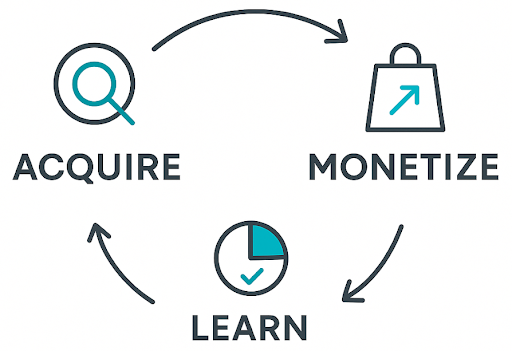
Build Your Compounding Loop in 3 Steps
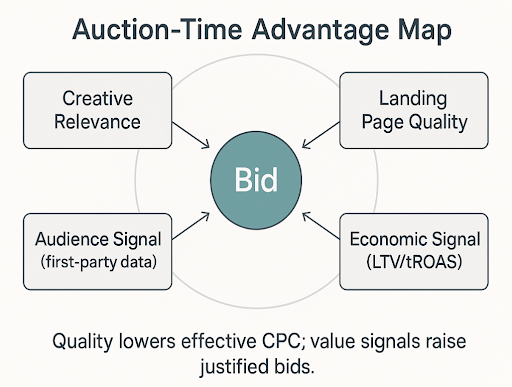
Google’s search ads run on versions of the generalized second-price auction. You can read more about GSP here, but in simple terms, how it works is you’re bidding for expected value after quality and relevance are priced in.
This has the practical implication that better ads and landing pages reduce your effective cost. It also means that blindly chasing the top spot often doesn’t pay off, unless the top has a meaningfully higher conversion rate and lifetime value. So here’s what you need to do:
1. Acquire with intent
Start with high-intent queries you can map to profit now (brand, competitor + “alternative,” SKU names, “buy,” “near me”) and a narrow set of match-types and negatives to control waste. Give each segment its own landing page with a tight message match.
2. Monetize beyond the first order
Build simple post-click multipliers such as order bumps, bundles, free-to-paid email journeys, and a one-time win-back. The goal here is to lift AOV by a few percent and repeat purchases by a few points. These tiny edges quickly compound to justify higher bids.
3. Feed signals back into bidding
Send clean, deduped conversion and value signals, including offline revenue where relevant, so your bidding model learns what you actually care about: gross profit. Over time, your bids can rise where LTV is strong and tighten where it isn’t.
Your wins will compound even more with rigorous experimentation. Sequenced A/Bs, uplift tests, and long-horizon objectives become the engine that turns small gains into a durable advantage.
Bid to the Right Target
If you’re chasing the lowest CPA, you bias the system toward short-term, low-value customers. For subscription or high-margin repeat products, switch to target return on ad spend (tROAS) or value-based bidding only after you’ve taught the system good value signals.
Start conservatively by tagging high-confidence conversions first (e.g., billed revenue or qualified deals), then add softer events later.
Academic and industry research continues to show that digital ads’ impact depends on context and the mix with other channels. Treat reported performance with skepticism until your own incrementality tests agree.
Expand Once Search Stabilizes
Google Ads scales best when supported by other digital levers, especially in B2B. If you’re weighing your next growth step, see our take on broader B2B digital marketing strategies and how channels interlock with sales cycles and privacy shifts. This should help you decide whether to push budget into search, content, or partnerships next.
Also, email and lifecycle messaging can double the value of every paid acquisition when done and predictably. If you decide to build that layer next, this piece on next-best-action emails shows how predictive rules can nudge second and third purchases without gimmicks, which is exactly what a compounding PPC system needs.
If you run influencer whitelisting or user-generated content in ads, be sure your disclosures travel with the creative. “Clear and conspicuous” is a standard that must work on every device and placement you use, because that clarity protects consumers and keeps campaigns from being disrupted by takedowns or complaints.
The Takeaway
Build a loop that turns search intent into profit, profit into better bids, and better bids into a durable advantage. If you keep your math honest and your disclosures clear, you won’t need “hacks.” You’ll have something better: a quiet, reliable compounding machine.

I’m Kishan Rana, an SEO professional and digital marketing specialist with over 8 years of hands-on experience in search engine optimization, organic growth strategies, and online visibility enhancement. I’m passionate about analyzing search algorithms, exploring ranking strategies, and helping businesses build sustainable traffic through data-driven SEO practices. Through Mashupmind, I share practical insights, industry trends, and actionable techniques designed to help brands grow smarter in the digital landscape.