
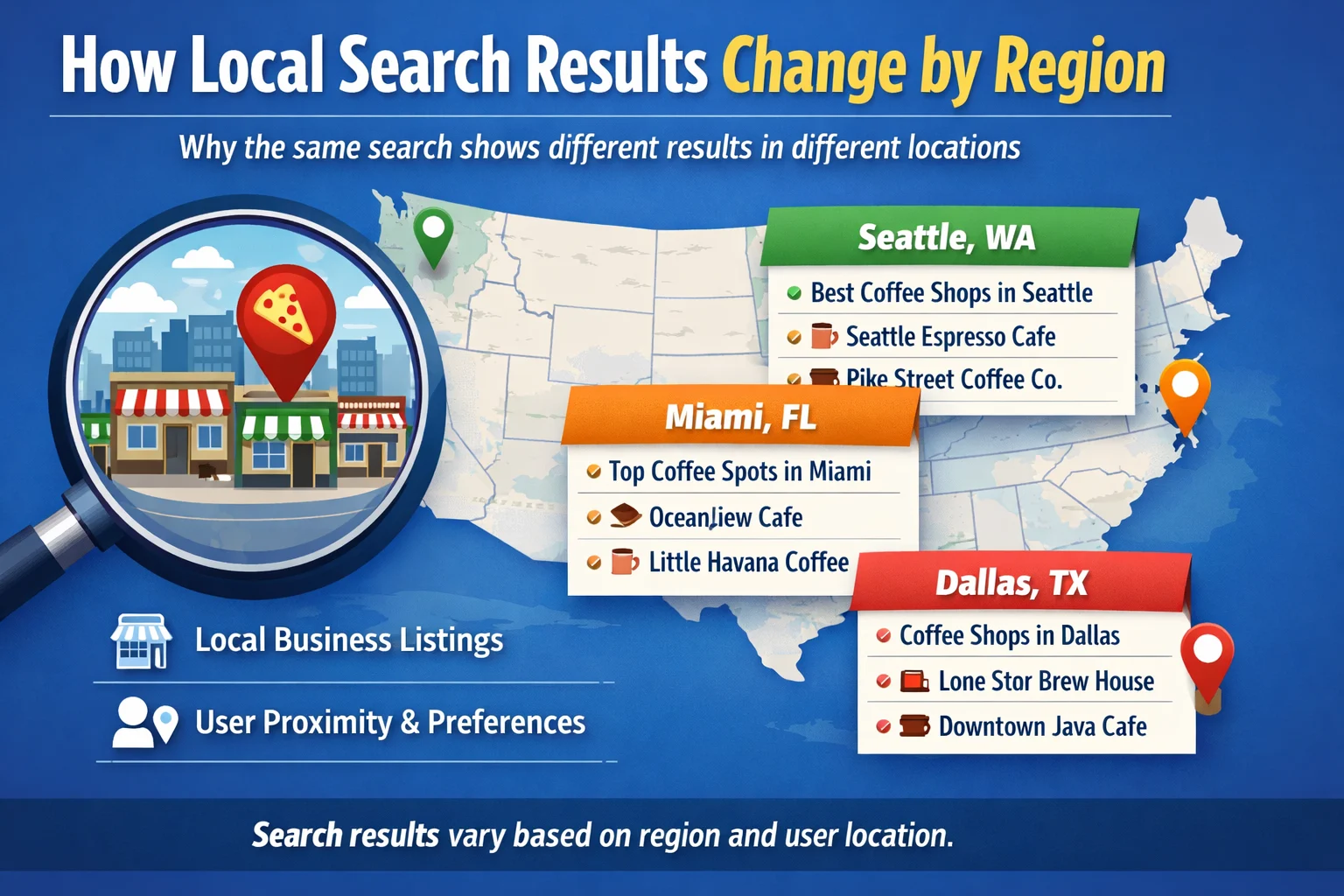
In some cases, pages that receive high rankings in one market receive radically different ratings in the rest of the regions. The reason for this is not the altered content quality. Search engine results are pages that adapt to context and usage patterns. Even small changes produce significant effects.
There is global search engine dominance in Google, according to StatCounter. It accounted for 89.8% of all requests at the start of 2026. Alternatives, such as Bing (~4.45%) and Yahoo (~1.37%), are far behind in this regard. Such proportions determine which sites will appear in the local search results.
Search behavior also varies by device. At the beginning of 2026, mobile devices contributed to approximately 51.29% of the overall web traffic globally. Desktops hover at about 48%. This shift on mobile devices affects prioritized features in local SERPs.
Let’s discuss the difference in search queries by country and their determinants.
How Regional Search Engine Usage Patterns Affect Results
Different market-specific usage is noted despite one provider having a dominant share globally of about 89.8%. This leader still holds close to 90% of the market in some regions in North America and Europe. Non-global engines dominate in China due to differences in ecosystems and regulations. The search engine results for identical keywords vary. In Eastern Europe or East Asia, a search query that is ranked first must be expected to be far from the first page when searched for. Different pages are boosted by different signals and indexes. Besides, the SERP layout is changing under the influence of trends in the development of devices. On phones than on desktops, the local packs and quick answer blocks before the traditional ones are more visible. The same is to be gained from the present understanding of the microtrends shaping content delivery in local searches.
Read: Best Api Search Company’s Homepage: A Complete Developer’s Guide For 2026!
Core Causes Of Regional Differences
There are a number of behavioral and technical factors that are linked to variance. Behavioral and Technical causes of Variance (there are a number of causes)
- IP Geolocation Accuracy. Search engines use IP addresses to identify the general location of a user. This will determine what specific results/services will be shown for the user, especially for queries with a local intent.
- Language/Regional Settings & Cultural Signals. Language settings on the user’s browser and the way cultures interpret intent will play a role in how a phrase that is regularly used in one regional market will be prioritized differently from a repeated phrase in a second market.
- Country Domain Signals. Country code domains are associated with the country and provide localised results.
- Local SERP analysis. If local information has been indicated, for instance, local business listings or maps, they are typically identified and have a further effect on organic rankings as they affect how far a page will be from the top or bottom of the local search results.
- User History & Trending. Regional click activity and popular topics are also indexed factors. Combined, these five indexing criteria explain why the same keywords vary in results based on location.
Tools And Methods
Accuracy in the analysis requires tools and methods that artificially simulate the genuine search settings in all the target regions.
- Proxies with Geo-Targeting. Proxies associated with particular carriers and cities retrieve the SERPs. Analysts get to compare results with no personalization noise when they utilize high-quality ISP proxies configured for critical markets.
- Rank Regional Trackers. Instead of using aggregated global ranks, rank tracking platforms that allow for country and city filters help with tracking performance state segments.
- Location Overrides Browser. They cannot replace proxy testing, but provide quick checks, like Chrome’s location simulation in DevTools.
- Manual Side by Side. Inspection: It is possible to determine where the results are coming from and why they are different using the same queries but sent from different machines, places, and language settings.
Therefore, when a combination of these tools is applied, the regional differences are ensured to be based on reality rather than test setup artifacts.
Interpreting Regional Rank Differences And When To Act
The analysis of the local results in several regions requires indicators of performance:
- Look for persistent rank disparities. That a page is ranking low in a region repeatedly is indicative of a structural optimization problem for the region.
- Different SERP layouts (e.g., local packs, FAQs) switch visibility. Having a high rank with no features may yield below having a low rank with featured snippets.
- A strong rank with low clicks may indicate a mismatched intent for that audience. The content’s tone or format may be adjusted.
- Comparative positioning against regional competitors identifies where the positioning suffers from content or signals.
Such metrics documented provide an indication of whether such differences are really reflective of a broad-gauged strategy or just aberrations and fluctuations in operational factors.
Actionable Steps To Improve Regional Visibility
Thus, improving local search results requires optimization efforts on:
- Rather than having one global set of keywords, find out which core keywords have popular variants in each region.
- Tailor content to regional language, culture, and preferences to improve relevance on local SERPs.
- Language and region tags implementation.
- Regular, frequent monitoring.
- Locally benchmark competitors.
These steps are then made in a structured way to provide improvements that envisage the actual case in regional searches.
Regional SERP Difference Examples
There are several consistent patterns in local search results:
- A page that ranks in the top three positions on a Google technical review in North America could rank on page two in Europe as a result of regional differences in indexing preferences.
- The same phrase will generate a business-specific query when used in an urban vs rural location, which would create different levels of user interest and engagement.
- Video and picture-based websites rank well in one location because they are being accessed through smartphones at a disproportionately higher rate than in other locations, affecting visibility.
Everywhere, we can see that local differences will have an impact on traffic models and conversion rates.
Regional Search Trends And The Broader Search Ecosystem
The overall search landscape is continually changing. As of early 2026, one of the major search engines continues to dominate, garnering approximately 89.8% of the worldwide market share, with other engines like Bing or Yahoo holding onto lower single-digit percentages. Mobile device usage for search traffic has recently been between 62% and 64%. Thus, the importance of creating/searching for local mobile SERPs is clear.
Additionally, the increase in use of artificial intelligence as a means of accessing/ engagement through a search interface creates additional complexity in the analysis of local search results. More and more users are utilizing various platforms (which are alternatives to a standard SERP) to find answers to their questions.
Technological advancements and changes in search consumer behaviour will also create ongoing evolution of the way we think about local SERP results.
Why It’s Important to Understand Regional SERPs
Being aware of how local markets in your area affect results in order to evaluate performance and optimize strategies accurately. Without this knowledge, regional performance metrics may hide a weakness or opportunity within a certain sector. Evaluating how users actually find content based on their geographic location will allow you to identify which regions may have higher/ lower rankings than would otherwise be predicted from total cumulative contributions from multiple regions.
Utilizing a combination of geo-targeted SERP testing, regional rank-tracking, and comparative analysis will allow you to enhance your visibility and engagement across all major segments of the market.
Areas of Challenges for Localizing Regional Content
Optimizing for localized content can create numerous recurring challenges that will impact how localized content appears in local search results. Key challenges include:
- Keywords do not translate directly between languages. Therefore, a high-volume keyword in English may have an entirely different phrase or structure in another language. As this happens, the ranking for that keyword may fluctuate by country for the same topic.
- Although meaning will translate, cultural relevance may not. The idioms, product names, and tone used may cause differing reactions from people living in the locations where the content appears. Things that are persuasive in one area may sound nonsensical in another, resulting in decreased engagement and click-through rates.
- Even though the formatting will be slightly different from region to region, the differences will still influence trust. Having a specific region’s formatting may be viewed as “foreign content” by potential customers and result in a higher number of people leaving, thus causing negative behavioural metrics.
- Product availability, disclaimers, and privacy laws vary from one market to another. Failure to take these differences into consideration can result in compliance issues and/or a lack of credibility in the regional search engine results pages.
- There are too many different localized versions of the regional content to manage at one time through a centralized control organisation. Compliance and verifiable version control are imperative when managing metadata, hreflang tags, and internal links on hundreds of regional pages; therefore, regular audits are essential to accomplishing this.
- Going outside of your original region’s culture when producing content centrally will fail to create meaningful regional and local content. Partnering with a native speaker in the region you are creating content for is essential to the success of your local content.
Strong localization fixes these weak points and strengthens search visibility across regions. The effort may be heavy upfront, but the long-term gain in engagement and stability across markets proves it worthwhile.
Bottom Line
The regional variations that exist in terms of how local searches show up have actual measurements associated with them. These variations do have a degree of significance. They can be utilized as ways to act upon or implement changes to content strategy. Certain types of geographical information can be factored into content strategy development in order to create more meaningful digital assets for potential customers who would be viewing these types of content in their market.

I’m Kishan Rana, an SEO professional and digital marketing specialist with over 8 years of hands-on experience in search engine optimization, organic growth strategies, and online visibility enhancement. I’m passionate about analyzing search algorithms, exploring ranking strategies, and helping businesses build sustainable traffic through data-driven SEO practices. Through Mashupmind, I share practical insights, industry trends, and actionable techniques designed to help brands grow smarter in the digital landscape.