Link building has evolved. What worked ten years ago doesn’t always get you to the top of B2B markets that are very competitive right now.
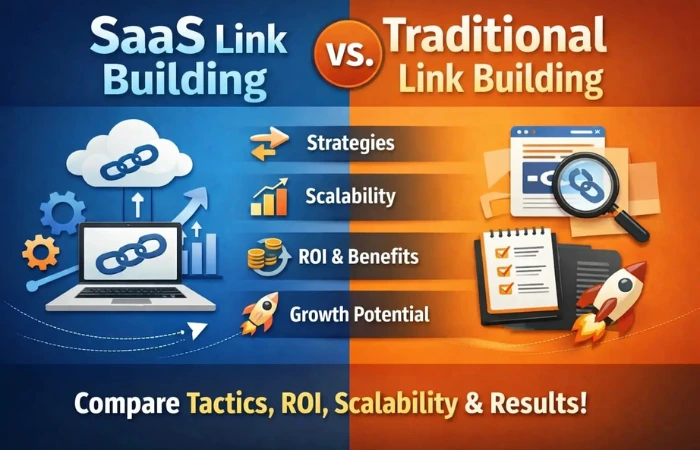
People are arguing about whether SaaS link building or standard link building is better from a business perspective. People who purchase SaaS tools compare them, check them, and see how well they work with other apps. They think about how much they will be worth in the long run.
Because of this, building links for SaaS requires a very different method than building links for other websites. It’s not just domain measurements that matter when it comes to building authority. In such cases, industry positioning, product context, and relevancy are all important.
Understanding the Core Difference
At a surface level, both SaaS and traditional link building aim to improve search visibility. That’s where the difference lies in editorial depth and intent alignment.
In traditional link building, getting backlinks from high-DA sites is often more important than making sure they are strictly related to the topic at hand. However, SaaS link building focuses more on contextual placement within industry-relevant conversations.
Editorial Relevance Over Domain Metrics
When comparing SaaS link building vs traditional link building, editorial relevance outperforms authority metrics.
When writing product comparisons, technical tutorials, industry research, or integration roundups, SaaS brands benefit from naturally placed links.
Why Editorial Relevance Matters for SaaS?
- Buyers consume niche, problem-focused content
- Search intent is highly commercial or solution-driven
- Context strengthens keyword rankings
- Google values topical authority clusters
Even if the business website has a higher DA score, a contextual link from a blog that reviews SaaS and talks about workflow tools will do better than a generic guest post on the site.
The Role of Product-Led and Thought-Leadership Links
Traditional link building is about generic guest posts. These are created particularly for backlink placement. Getting a SaaS link is different because it is based on assets.
Product-Led Link Building
SaaS companies can leverage product features, integrations, and use cases to earn high-quality links.
Effective product-led link strategies include:
- Integration announcement partnerships
- Comparison pages (vs competitors)
- Feature deep dives
- Use-case landing pages
- Case study collaborations
These links are harder to replicate and far more defensible. They reinforce both SEO and brand positioning.
Thought-Leadership and Data-Driven Assets
SaaS brands that publish original research, industry reports, and expert commentary attract organic citations.
High-performing thought-leadership assets include:
- Benchmark reports
- Industry trend analyses
- Founder insights
- Original survey data
- Technical whitepapers
If you compare saas link building to regular link building, this is where SaaS strategies really shine. They establish authority by providing value, as opposed to inserting links into irrelevant content.
Why Do Generic Link Vendors Fail SaaS Companies?
Many traditional link vendors operate with templated outreach lists and standardized publisher networks. This particular approach may generate backlinks. However, it rarely generated meaningful SEO growth.
- Lack of Industry Context
- Generic vendors do not understand:
- Buyer journey of SaaS
- ICP content
- Product positioning
- Competitive keywords
Without proper context, it might look like links have been forcefully added to pages.
No Funnel Alignment
SaaS SEO needs links that support:
- Feature and solution pages
- Integration pages
- Comparison pages
- Commercial landing pages
Traditional vendors build links to blog posts and ignore the revenue-driving URLs.
Weak Editorial Standards
A lot of time mass link vendors rely on
– low engagement websites
– thin content publishers
– networks built for SEO
These links may inflate metrics but rarely improve qualified traffic or rankings in competitive SaaS niches.
Final Thoughts
The difference between SaaS link building vs traditional link building lies in strategic depth. Traditional link is about metrics and volumes.
SaaS link building is about prioritizing product integration, thought leadership, and editorial relevance. Backlinks must strengthen authority, expertise, and buyer trust for SaaS brands that are competing in markets that are already full.
These days, contextual value always beats generic scale in SEO.

I’m Kishan Rana, an SEO professional and digital marketing specialist with over 8 years of hands-on experience in search engine optimization, organic growth strategies, and online visibility enhancement. I’m passionate about analyzing search algorithms, exploring ranking strategies, and helping businesses build sustainable traffic through data-driven SEO practices. Through Mashupmind, I share practical insights, industry trends, and actionable techniques designed to help brands grow smarter in the digital landscape.