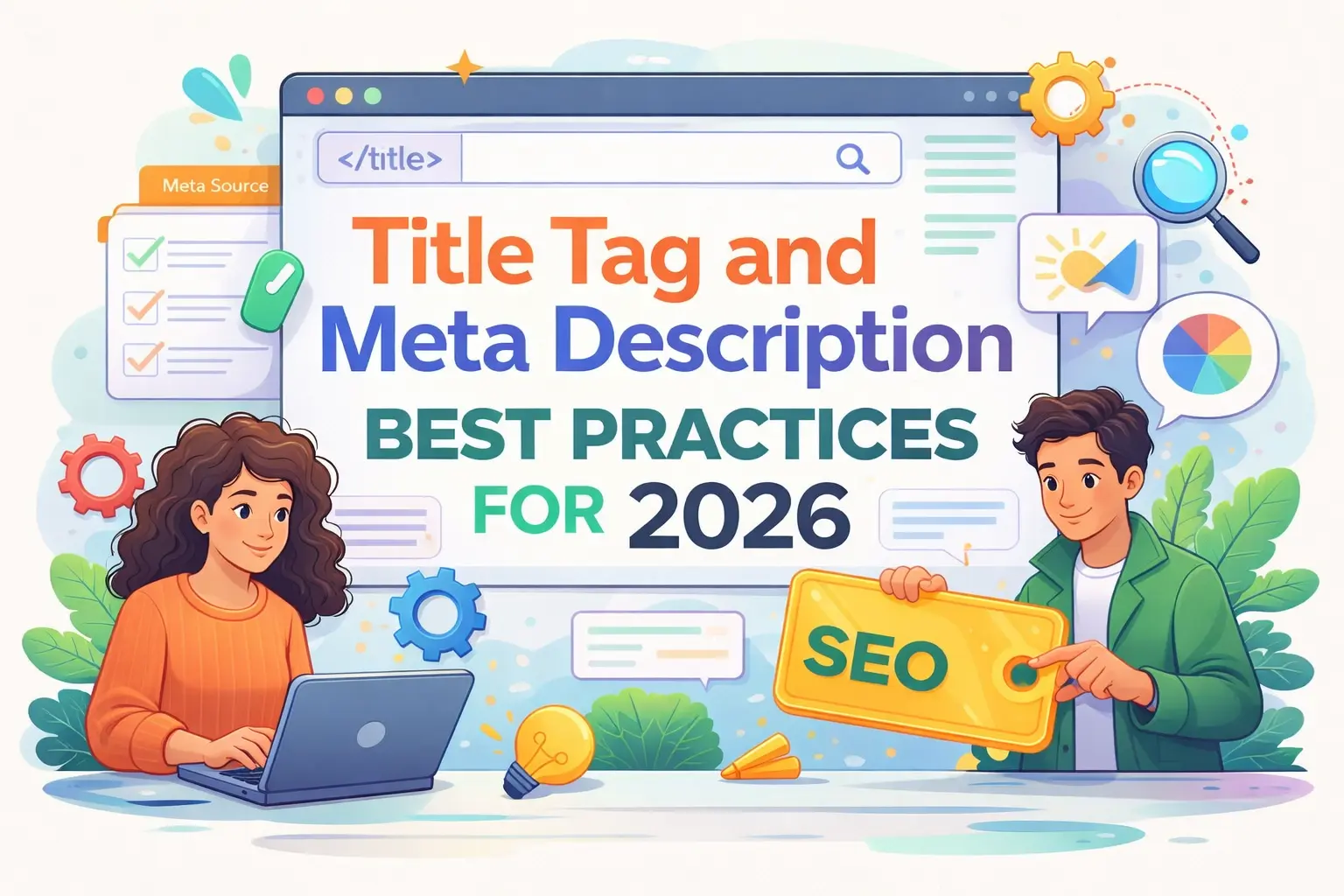
The title tags and meta descriptions of a webpage function as essential components for on-page SEO because they establish how search engines and users will view the webpage. The elements affect three main website performance metrics, which are click-through rates(CTR), search visibility and user engagement. The content of a title and its corresponding meta description will lead users to visit your webpage instead of your competing websites.
The process of updating your metadata according to existing best practices will maintain your page content throughout 2026 while preserving its competitive edge. The first impression that search engine results pages (SERPs) create through their metadata shows its importance as an essential part of search engine optimisation (SEO) methods. The optimisation process of these elements enables websites to improve their search rankings while creating better experiences for their visitors.
What is a Title Tag?
A title tag is an HTML element which establishes the title of a webpage. The title appears in search engine results and browser tabs to provide users and search engines with a summary of the page content.
The title tag functions as a key on-page SEO element which determines website rankings according to search engines. The title tag helps search engines determine the main subject matter and importance of a website page. The title tag creates better search engine results page visibility, which leads to higher user engagement and website traffic because it optimises title display.
What is a Meta Description?
A meta description serves as an HTML attribute that delivers a short overview of a webpage’s content. The description appears underneath the title in search results to provide users with content information before they click.
Although meta descriptions are not a direct Google ranking factor, they strongly influence CTR. A description that effectively captures the website content makes users more likely to click, which results in higher website traffic and user participation. Meta descriptions provide clear page summaries that simultaneously enhance user experience and improve search engine performance.
Ideal Length
The required length of title tags and meta descriptions needs to be maintained at specific standards because search results will truncate any content that exceeds those limits.
- Title tag: Please ensure the titles are within 50-60 characters in length. Google can display short, readable titles in full on the SERPs. Users can easily digest them.
- Meta description: The ideal length for descriptions is 150 to 160 characters because longer descriptions create issues that decrease both understanding and click-through rate possibilities.
Compacting meta text would lead to users perceiving what the page is about at a faster pace; thus, receiving the return of convincing the visitor to click.
Title Tag Best Practices
There are several key practices in title tag optimisation:
- Keyword placement: Include the primary keyword towards the beginning to achieve improved SEO relevance.
- Clarity: Choose readable and simple titles. Do not conjure up complicated sentences.
- Character limit: It is considered advisable for SEO purposes to keep meta titles within a range of 50 to 60 characters.
- Uniqueness: To aid search engines in distinguishing content, each page should have a unique title.
Components are the foundation of every web page, embedded in different parts where they deliver a particular message or function.
Meta Description Best Practices
The meta description should simply tell them what follows after clicking.
- Clear summary: Clarify what users may expect from the page in plain, nontechnical language.
- Keyword usage: Keywords should be included naturally and should not be overused in a single paragraph.
- Call-to-action (CTA): Use expressions such as “Learn More,” “Discover,” or “Get Started” to encourage clicks from visitors.
- Avoid duplicates: In order to avoid self-competition, the SERP description should be unique for each page.
The better the meta description, the more clicks there will be the number of clicks bouncing and the better the value of the page effectively communicated to the users.
Common Mistakes
Many acts of ignorance hamper the performance of the SEO of the website.
- Keyword stuffing: It is the high density of keywords in titles and descriptions that makes it look like spam or unnatural in appearance.
- Missing metadata: Those pages are asked to be gone, like not labelled or described.
- Duplicate metadata: Reusing titles or descriptions across pages is an offence- search engines get confused by it and will give weakened rankings if found.
Abandoning them errs on the side of on-page SEO and search performance.
The Role of Metadata in SEO
Search engines and users use title tags and meta descriptions to interact with your web pages. Users who see your meta descriptions will decide to click your links because they create an effective first impression, which boosts user engagement metrics.
Optimised metadata results in proper signals that show both relevant content and professional standards. Users are more likely to click on pages that clearly communicate value, which can indirectly boost rankings by reducing bounce rates and increasing time on page.
Technical Considerations for 2026
Technical SEO factors must be kept at the forefront while enhancing metadata in 2026.
- Always make sure that headings and meta descriptions follow proper HTML guidelines.
- Try not to truncate and see if you are able to adjust the word count.
- Employ structured data when viable to elevate SERP display mode.
- Metadata should always be in sync with the content to maintain the relevance of the information, as well as regain trust and credibility of the user.
The recalibrations serve in order to heighten the metadata quality in the search results of today.
Enhancing CTR with Metadata
The combination of a properly optimised title with an effective meta description leads to substantial improvements in click-through rates(CTR). The presence of specific advantages together with essential terms and direct call-to-action elements enables users to understand the value of your link.
The combination of the title “Best SEO Tools for 2026 | Boost Your Rankings” with the meta description “Discover top SEO tools to improve rankings, traffic, and CTR. Learn how to optimize your website effectively today” creates a more effective click-attracting system than standard metadata.
Tracking Metadata Performance
You should monitor your title tags and meta descriptions through SEO tools, which include Google Search Console, SEMrush and Ahrefs. The process involves tracking impressions and CTR along with ranking positions to detect which pages require optimization.
To ensure the relevance of their pages, competitively, websites must audit their metadata on a regular basis, especially as algorithms and behaviours of users are evolving.
Conclusion
Title tags and meta descriptions are vital for SEO and CTR. The elements deliver precise content details to both search engines and users, which leads to increased click-through rates and better content visibility.
The combination of optimised metadata through clear title usage and summary implementation, natural keyword distribution and effective CTA design will function as a primary on-page SEO technique in 2026. The process of maintaining metadata requires continuous effort because it helps websites draw their target audience while increasing user interaction and boosting their search engine ranking.
Treat title tags and meta descriptions as your first impression in search results. By creating distinct, pertinent and captivating metadata for every individual page, websites will achieve higher click-through rates while improving their search engine optimisation and maintaining their search engine market position.

Harsh Mistri is a Digital Marketing Executive with over 8 years of experience in SEO, online marketing, and growth strategies. He is passionate about exploring the evolving digital landscape and enjoys writing about technology, SEO, and digital marketing.