Your website gets visitors. But how many of them actually do what you want — buy a product, fill a form, book a call, or sign up for a trial? If the answer is “not enough,” you do not always need more traffic. You need conversion rate optimization.
Conversion rate optimization, or CRO, turns more of your existing visitors into leads and customers. It costs less than buying more traffic, and it makes every marketing channel you already run — SEO, PPC, social media, and email — work harder. This guide explains what CRO is, how it works, the exact process to follow, proven strategies, tools, and benchmarks, plus how to pick a conversion rate optimization agency if you want expert help.
What Is Conversion Rate Optimization?
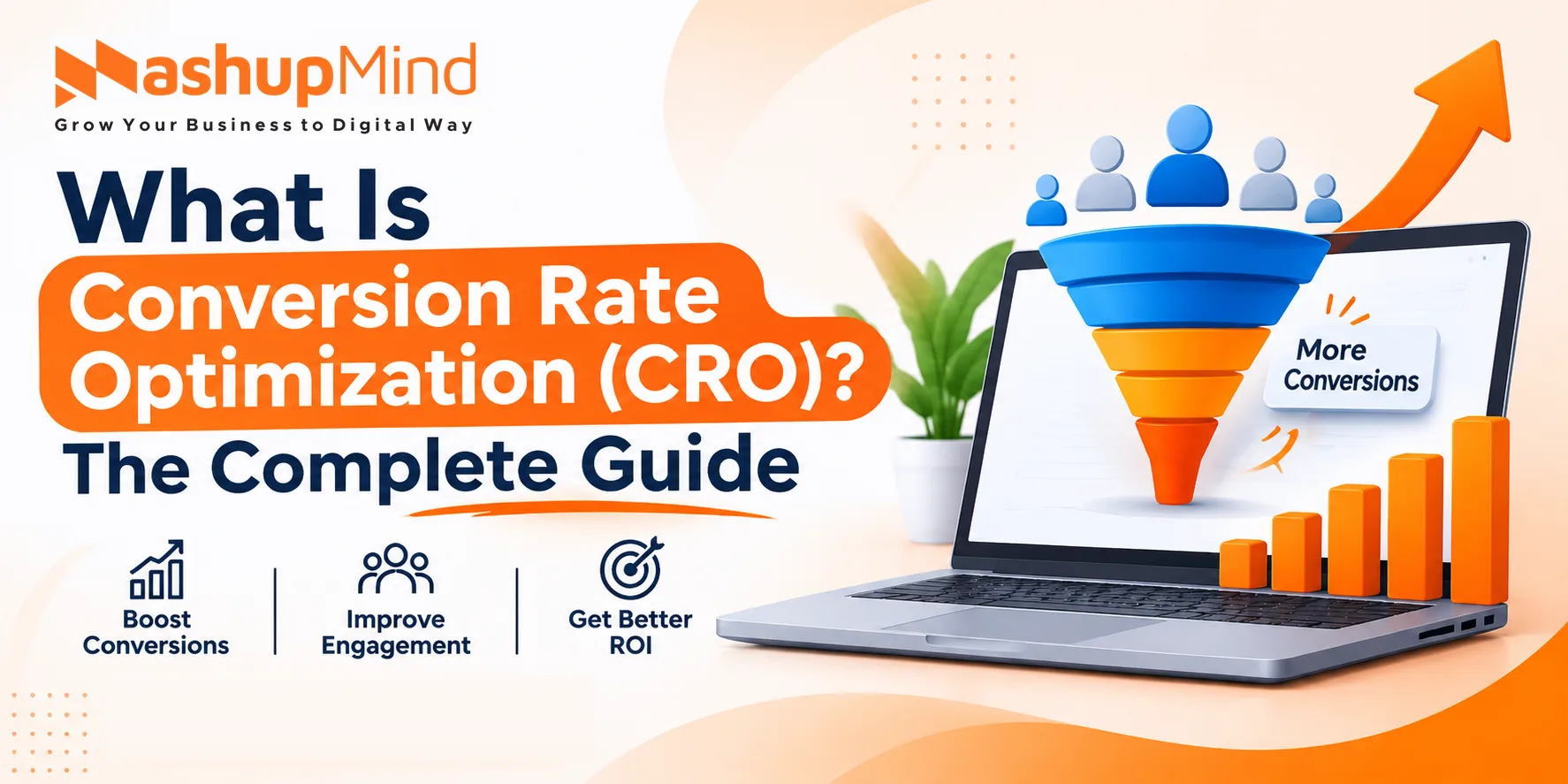
Conversion rate optimization is the structured process of improving your website and landing pages so a higher percentage of visitors take a desired action. That action is called a conversion. A conversion can be a purchase, a form submission, a phone call, a demo booking, a download, or a newsletter signup — whatever matters most to your business.
CRO is not guesswork. You study how visitors actually use your site, find the points where they hesitate or drop off, form a clear hypothesis about what will fix it, and test the change before you roll it out. You keep the winners and discard the losers. Over time, small wins compound into large gains.
Here is a simple example. Your landing page gets 10,000 visitors a month and converts at 2%. That gives you 200 leads. If CRO lifts the rate to 3%, you get 300 leads from the same traffic — 50% more leads with zero extra ad spend.
How to Calculate Your Conversion Rate
Use this formula:
Conversion Rate = (Total Conversions ÷ Total Visitors) × 100
Count conversions and visitors over the same period. If 1,000 people visit your product page in a month and 25 of them buy, your conversion rate is (25 ÷ 1,000) × 100 = 2.5%.
Track the rate separately for each page, traffic source, and device. Your homepage, your pricing page, and your checkout page convert at very different rates, and blending them hides the real problems. Google Analytics 4 (GA4) shows conversions by page, source, and device, so start there.
Why Does Conversion Rate Optimization Matter?
Traffic is expensive. Click costs keep rising — WordStream’s 2026 Google Ads benchmarks put the average cost per click at $5.42, while the average conversion rate across campaigns was 8.18%. Every visitor who leaves without converting wastes part of that spend. CRO recovers that waste.
CRO also improves the return on everything else you do. Better landing pages lift Quality Score in Google Ads, which can lower your cost per click. Clearer pages keep visitors longer, which supports your SEO results. And the research behind CRO — surveys, heatmaps, session recordings — tells you exactly what your customers care about, which improves your messaging everywhere.
Conversion Rate Benchmarks for 2026
Benchmarks are a starting point, not a target. Your ideal rate depends on your industry, offer, price, and traffic source. Still, these widely cited figures show where most businesses stand:
| Metric | Benchmark | Source |
|---|---|---|
| Median landing page conversion rate | 6.6% | Unbounce, 2025 (41,000 pages, 57M conversions) |
| Average ecommerce conversion rate | About 2.7% | Dynamic Yield |
| B2B lead generation conversion rate | 2–5% | Industry range |
| Average Google Ads conversion rate | 8.18% | WordStream, 2026 |
| Average cart abandonment rate | About 70% | Baymard Institute |
Notice the gap: the median landing page converts at 6.6%, while the average online store converts at about 2.7%. The difference is intent. A focused landing page with one offer converts far better than a general product catalogue. That gap is exactly where CRO finds its wins.
CRO vs SEO: What’s the Difference?
People often confuse CRO with SEO. They work together, but they solve different problems. SEO brings visitors to your website. CRO turns those visitors into customers.
| SEO | CRO | |
|---|---|---|
| Goal | Rank higher and get more traffic | Convert more of the traffic you already have |
| Focus | Keywords, content, backlinks, technical health | Pages, forms, offers, user experience, testing |
| Main metric | Organic traffic and rankings | Conversion rate and revenue per visitor |
| Time to results | Weeks to months | Days to weeks per test |
You need both. Traffic without conversion wastes your SEO effort. Conversion work without traffic has nothing to optimize. The best results come when you run them together: SEO fills the funnel, CRO widens the bottom of it.
How to Do Conversion Rate Optimization: The 7-Step Process
Follow this process in order. Skipping the research steps and jumping straight to testing is the most common reason CRO programs fail.
Step 1: Define Your Goals and Conversions
Pick one primary conversion per page. A landing page should ask for one action — book a demo, request a quote, or buy now. List your macro conversions (purchases, leads) and micro conversions (video plays, scroll depth, add-to-cart) so you can measure progress even before the final sale.
Step 2: Collect Data
Open GA4 and find your worst leaks: pages with high traffic and low conversion, and funnel steps with the biggest drop-offs. Add a heatmap and session recording tool such as Microsoft Clarity or Hotjar. Watch real visitors. You will see rage clicks, confusing menus, and forms people abandon halfway — problems no report can show you.
Step 3: Talk to Your Visitors
Run a short on-site survey with one question: “What stopped you from completing your purchase today?” Read support tickets, sales call notes, and product reviews. Customers describe friction in their own words, and those exact words often become your best headlines.
Step 4: Form a Hypothesis
Write every test idea in this format: “If we change X, then Y will happen, because Z.” For example: “If we shorten the demo form from 9 fields to 4, demo requests will rise, because visitors abandon long forms.” A clear hypothesis keeps tests honest and results useful.
Step 5: Prioritize Your Tests
Score each idea on potential impact, confidence, and ease. Test high-impact, easy changes first — a clearer headline, a stronger call to action, a shorter form. Save complex redesigns for later, after the quick wins fund them.
Step 6: Run A/B Tests
Show half your visitors the original page (control) and half the new version (variation). Change one thing at a time so you know what caused the result. Let the test run until it reaches statistical significance — usually at least one to two full business cycles, including weekends. Ending a test early because the first day looks good is the fastest way to ship a false winner.
Step 7: Analyze, Apply, and Repeat
Roll out the winner, document what you learned, and move to the next hypothesis. CRO never ends. Customer behaviour, competitors, and traffic sources keep changing, so your pages must keep improving with them.
10 Proven CRO Strategies That Work
1. Put a Clear Value Proposition Above the Fold
Visitors decide in seconds whether to stay. Your headline must say what you offer, who it is for, and why it beats the alternative — in one short sentence. Support it with a subheadline that names the main benefit and a single call to action.
2. Use One Call to Action per Page
Pages with a single CTA convert at 13.5% on average, while pages with two to four competing CTAs convert at 11.9%, according to Unbounce. Every extra button splits attention. Pick the one action that matters and repeat that same button, not different ones.
3. Shorten Your Forms
Ask only for the information you need to take the next step. Name, email, and phone number are enough for most lead forms. Move extra questions to the sales call or the onboarding step. Each field you remove lifts completion rates.
4. Speed Up Your Pages
Google’s research shows the probability of a bounce rises 32% as page load time goes from 1 second to 3 seconds. Compress images, remove unused scripts, and test your key pages on a real phone over a mobile connection — not just on office Wi-Fi.
5. Add Trust Signals Near the Decision Point
Place reviews, client logos, guarantees, and security badges close to the form or buy button — not buried at the bottom of the page. People look for reassurance at the exact moment they hesitate.
6. Design Mobile-First
Most traffic now arrives on a phone, yet most pages are still designed on a desktop. Check your forms, buttons, and checkout on a small screen. Buttons must be thumb-sized, text must be readable without zooming, and the page must not shift while it loads.
7. Use Real Social Proof
Show specific results, not vague praise. “We increased demo bookings by 48% in 60 days” convinces far more than “Great service!” Use customer names, companies, and photos wherever your clients allow it.
8. Personalize by Traffic Source
A visitor from a Google search for “emergency plumber” needs a different page than one from a Facebook ad about bathroom renovation. Match the headline and offer to the ad or keyword that brought them. Message match alone can lift conversions sharply.
9. Recover Abandoners with Exit-Intent Offers
When a visitor moves to leave, show one relevant offer — a discount, a free guide, or a callback request. Keep it simple and honest. One well-timed offer beats five popups that fire on arrival.
10. Simplify Your Checkout
Offer guest checkout, show a progress bar, display the total cost early (including shipping), and accept the payment methods your customers actually use. With average cart abandonment near 70%, checkout friction is the single most expensive leak in ecommerce.
Ecommerce Conversion Rate Optimization
Ecommerce CRO deserves its own focus because the funnel is longer and the leaks are more expensive. A store converting at 2% that lifts to 3% grows revenue 50% from the same traffic.
Start with product pages. Use clear photos from several angles, a short video where possible, and benefit-led descriptions — not just specifications. Show delivery time, return policy, and stock status before the buy button, because shoppers check these before they commit.
Next, fix the cart and checkout. Baymard Institute’s research puts average cart abandonment at about 70%, and the top reasons are always the same: extra costs at checkout, forced account creation, slow delivery, and a long or confusing process. Show all costs early, offer guest checkout, and cut the checkout to as few steps as possible.
Finally, recover the abandoners. Send a cart reminder email within one hour, then a second one with a small incentive within 24 hours. Add reviews and user photos to product pages, and test a free-shipping threshold — it raises average order value as well as conversions. If you sell on marketplaces too, pair store CRO with professional ecommerce account management so your listings, ads, and store improve together.
Best Conversion Rate Optimization Tools
You do not need an expensive stack to start. These tools cover the full CRO workflow:
- Google Analytics 4 (GA4): Free. Tracks conversions, funnels, traffic sources, and device behaviour.
- Microsoft Clarity: Free. Heatmaps and session recordings that show exactly how visitors use your pages.
- Hotjar: Heatmaps, recordings, and on-site surveys in one tool.
- VWO: A/B testing, multivariate testing, and personalization for growing teams.
- Optimizely: Enterprise-grade experimentation platform for large sites.
- Google Search Console: Free. Shows which queries bring traffic, so you can match pages to real search intent.
Pick one analytics tool, one heatmap tool, and one testing tool. Master those three before you buy anything else.
Conversion Rate Optimization Services: What Does an Agency Do?
Conversion rate optimization services cover the full process above, done for you. A good service starts with an audit of your analytics, funnels, and key pages. Then it runs user research — heatmaps, recordings, surveys, and competitor analysis — and builds a prioritized testing roadmap.
From there, the agency designs and builds test variations, runs A/B tests, analyzes the results, and rolls out the winners. You get a monthly report that shows what was tested, what won, what lost, and what it added in leads or revenue. The best agencies also connect CRO with your other channels: Meta Ads landing pages, PPC landing pages, and content all improve when one team owns the full journey from click to conversion.
How to Choose a Conversion Rate Optimization Agency
Use this checklist before you hire anyone:
- Ask for real case studies: Look for before-and-after conversion rates with context — traffic, timeframe, and what changed. Vague claims without numbers are a warning sign.
- Check the process: The agency should describe research, hypotheses, prioritization, and testing — not just “we will redesign your site.”
- Demand transparency: You should see every test, every result, and every rupee or dollar spent. Avoid agencies that hide their tests or report only wins.
- Confirm they test, not guess: Redesigns without A/B testing are opinions, not optimization. Ask how they reach statistical significance and how long tests run.
- Check the team: Good CRO needs analytics, UX, copywriting, and development together. A one-person freelancer rarely covers all four.
- Avoid guaranteed rankings or guaranteed conversion rates: No honest agency guarantees a specific rate. They guarantee a rigorous process and measurable improvement over time.
Common CRO Mistakes to Avoid
Testing without a hypothesis: Random changes produce random results you cannot learn from.
Ending tests too early: A test needs enough visitors and at least one full business cycle. Early results mislead.
Changing many things at once: If you change the headline, image, form, and button together, you will never know which change worked.
Copying competitors: Their audience, offer, and traffic differ from yours. Their winning page can be your losing page.
Ignoring mobile: Most of your traffic is on a phone. A page that converts on desktop but breaks on mobile leaks most of your budget.
Chasing traffic instead of conversions: More visitors to a broken page just means more people leaving. Fix the page first, then scale the traffic.
Frequently Asked Questions About Conversion Rate Optimization
What is conversion rate optimization?
Conversion rate optimization (CRO) is the process of improving your website so more visitors take a desired action, such as buying, signing up, or requesting a quote. It uses data, user research, and A/B testing to find and fix the friction that stops visitors from converting.
How do I start conversion rate optimization?
Start by defining your main conversion, then measure your current rate in GA4. Find your biggest drop-offs with funnel reports, watch session recordings to see where visitors struggle, form one clear hypothesis, and run your first A/B test on your highest-traffic page.
What is a good conversion rate?
It depends on your industry and offer. As a rough guide, the median landing page converts at 6.6% (Unbounce, 2025), the average online store at about 2.7%, and B2B lead generation pages at 2–5%. Compare yourself with your own past performance first, then with industry benchmarks.
What is the difference between CRO and SEO?
SEO brings more visitors to your site through search rankings. CRO turns more of those visitors into leads and customers. SEO grows traffic; CRO grows revenue from the traffic you already have. They work best together.
How long does CRO take to show results?
A single A/B test usually takes one to four weeks, depending on your traffic. You can see early wins within the first month, but meaningful, lasting improvement builds over three to six months of continuous testing.
How much do conversion rate optimization services cost?
Costs depend on your traffic, the number of pages, and the scope of testing. A one-time CRO audit costs far less than an ongoing monthly program with design, development, and testing included. Ask for a custom quote based on your site and goals rather than a flat package.
Start Turning More Visitors into Customers
Conversion rate optimization is the highest-leverage work in digital marketing. You already paid for your traffic — through SEO, ads, and content. CRO makes sure that traffic pays you back. Start with one page, one hypothesis, and one test. Measure honestly, keep the winners, and repeat.
If you want expert help, MashupMind runs CRO alongside PPC, SEO, and landing page optimization from Ahmedabad, so your full funnel improves together — not in pieces. Check the on-page SEO checklist and the SaaS PPC benchmarks guide to see how we approach optimization, then contact us for a free consultation and a CRO audit of your website.

I’m Kishan Rana, an SEO professional and digital marketing specialist with over 8 years of hands-on experience in search engine optimization, organic growth strategies, and online visibility enhancement. I’m passionate about analyzing search algorithms, exploring ranking strategies, and helping businesses build sustainable traffic through data-driven SEO practices. Through Mashupmind, I share practical insights, industry trends, and actionable techniques designed to help brands grow smarter in the digital landscape.